Why is it worth entering PV cleaning? Growing market, recurring revenues, and scalable business models through modern robotic technology.



Startseite ❯ Solar-Fachartikel ❯ Expert Knowledge ❯ What does an uncleaned solar system really cost you?
Avoid up to 30% yield loss
Dirt on solar modules isn’t an aesthetic issue—it’s a measurable cost factor. Depending on system type and location, soiled photovoltaic systems can lose between 5% and 30% of their annual yield. Agricultural rooftop systems, low-pitch commercial roofs and ground-mounted systems in dusty regions are particularly affected.
Using concrete example calculations, this article shows what financial losses can result from soiled solar modules, when professional cleaning pays off, and why cleaning not only improves yield but also contributes to operational safety and long-term value retention.
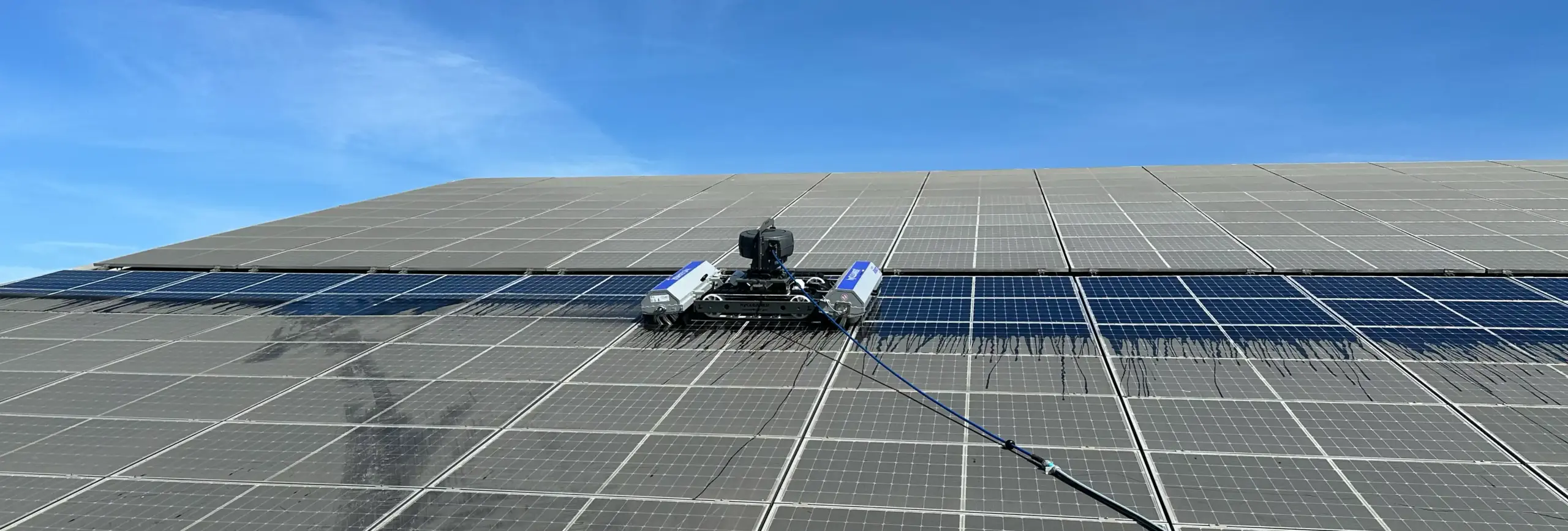
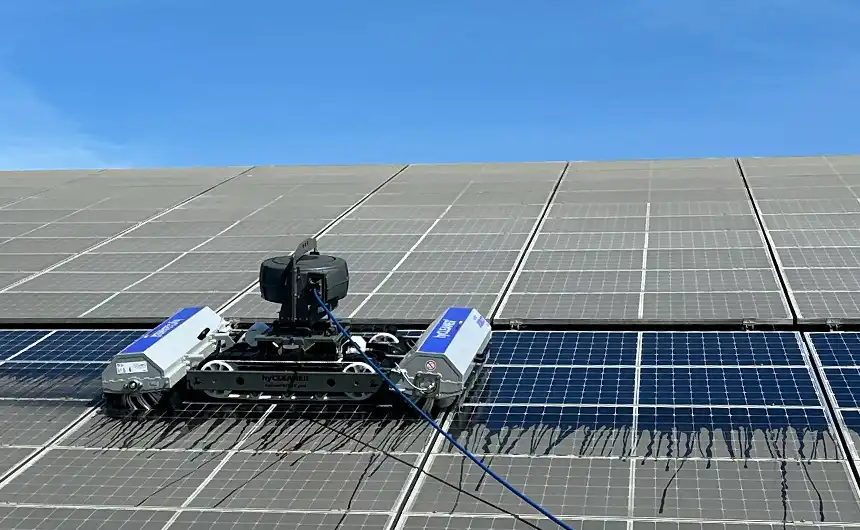
“The next rain will clean it” is a phrase that stubbornly persists among PV system operators. But it’s only partly true. While heavy rain can partially wash off loose dust and pollen on sufficiently steep roof surfaces, many stubborn types of soiling remain permanently stuck to the modules.
These include, among other things, bird droppings, ammonia deposits from barn air, oily soot films, lichens, moss, Saharan dust minerals and baked-on dust crusts. Even heavy rainfall cannot fully remove these residues, and they permanently impair the performance of the PV system.
The first continent-wide study on so-called soiling losses in Europe (DLR, CIEMAT and the University of Jaén, published in 2024 in Renewable Energy) shows: Even with a rain cleaning effect of just 10%, annual yield losses can rise to as much as 5.3%, and regionally even to 14%. Germany is in the European mid-range—but what always matters is the specific location and system type.
For this reason, we look at the three most important operator groups separately below: agriculture, commercial roofs and ground-mounted systems. Using concrete example calculations, we show the financial impact soiling can have and when professional cleaning pays off.
“Dirt on PV modules isn’t an annoyance—it’s a quantifiable cost factor. Anyone who underestimates their system’s cleaning needs often gives away valuable electricity yields year after year.”
Josha Kneiber, Geschäftsführer hyCLEANER
Agricultural PV systems are among the systems most at risk of soiling in Germany. Barn air, ammonia, pollen and harvest dust cause dirt to adhere particularly stubbornly to the modules. The following examples show why agricultural systems are especially affected, when cleaning makes sense, and how soiling can impact profitability.
Agricultural PV systems are the most heavily soiled system category in Germany. The reason is the unique emissions profile: Exhaust air from barns contains ammonia, fine dust from bedding, feed residues and organic aerosols that, under sunlight, literally bake onto the hot module surface. Add to that pollen, harvest dust and—especially in animal husbandry—biologically active particles that promote moss and lichen growth. Lichens grow firmly into the module surface and can no longer be removed without mechanical wet cleaning.
Even soiling that is barely visible can, according to industry surveys, cause yield losses of more than 6%. For typical barn-roof systems, losses of 10% to 25%—and in extreme cases up to 30%—have been documented. This is confirmed by both the German Agricultural Society (DLG) and practical surveys by agrarheute.com. In addition, there is the so-called dirt-amplifier effect: Once modules are soiled, they bind new dust particles far better than smooth, clean module surfaces—dirt attracts dirt.
The DLG (German Agricultural Society) recommends two cleanings per year, aligned with the agricultural annual cycle.
After the flowering season (May/June)
Pollen from birch, linden and maple leaves a sticky film. Together with barn dust, this creates a layer that rain can no longer remove. Since PV systems generate around 65% to 75% of their annual yield between March and September, cleaning before or at the start of this phase delivers the greatest economic benefit.
After the harvest (August/September) or before winter
Harvest work stirs up large amounts of dust. Especially on systems above grain and rapeseed fields, this leads to a second pronounced wave of soiling. Cleaning in autumn ensures that the winter months can also be used with the highest possible performance.
Special considerations for Agri-PV systems
Agri-photovoltaic systems with elevated module structures place additional demands on cleaning. Greater module heights, sloped terrain and wider row spacing require adapted cleaning concepts. However, the most economically sensible cleaning times remain the same: after winter and after the harvest.
A typical barn-roof system makes it clear what financial impact even moderate soiling can have. The following example calculation shows the relationship between yield loss, cleaning costs and potential economic benefit.
| System size | 500 kWp |
| Specific annual yield (DE average) | 950 kWh/kWp |
| Annual generation (target) | 475,000 kWh |
| Revenue per kWh (EEG + self-consumption, blended calculation) | 0.12 €/kWh |
| Annual revenue with a clean system | €57,000 |
| Yield loss at 15% soiling | 71,250 kWh → €8,550 per year |
| Yield loss at 25% soiling | 118,750 kWh → €14,250 per year |
| Professional cleaning (2× per year) | approx. €6,000–€10,000 |
| Net benefit (15% scenario) | slight loss of up to €2,550 per year |
| Net benefit (25% scenario) | €4,250–€8,250 per year |
| Purchase | from €21,990 (incl. charging station, CE-certified) |
| Annual operating costs | minimal (electricity, water, wear parts) |
| Loss avoidance (15% scenario) | €8,550 per year |
| Payback (single system) | approx. 3 years |
| Multiple systems (e.g., machinery ring) | payback can be reduced to 1–2 years |
| Purchase | from €34,000 (incl. charging station, CE-certified) |
| Annual operating costs | minimal (electricity, water, wear parts) |
| Loss avoidance (15% scenario) | €8,550 per year |
| Payback (single system) | approx. 4–6 years |
| Multiple systems (e.g., machinery ring) | payback can be reduced to 2–3 years |
While agricultural systems are primarily affected by ammonia, barn dust and organic deposits, commercial and industrial roofs place different demands on cleaning. Low roof pitches, industrial emissions and permanently deposited fine dust mean that significant yield losses can occur here as well.
While agricultural PV systems are mainly affected by ammonia, pollen and organic deposits, commercial rooftop systems face different challenges. Low roof pitches, industrial emissions and permanently deposited fine dust mean that rain alone often isn’t enough to keep the modules clean.
Industrial rooftop systems are usually installed parallel to the roof with a very low pitch (5–15°) or as an east-west mounting with a 10–15° pitch. This makes economic sense: On a 100 m² flat roof, an east-west configuration can fit up to 40% more modules than a classic south-facing orientation—without mutual shading. The downside: rain has hardly any self-cleaning effect. Dirt collects at the lower module frame, and dust and fine particles remain permanently in place at low pitch.
Compounding this, commercial sites are often located in close proximity to emission sources—for example along major traffic routes, near logistics centers or production facilities. Soot, brake dust and organic particles continuously deposit on the modules and can permanently impair power generation.
For commercial and industrial roofs, the optimal cleaning interval depends primarily on roof pitch and surrounding conditions.
| Roof-parallel / flat roof (0–10°) | 3–4× per year – No self-cleaning effect, high dust accumulation at the module frame. |
| South-facing mounting (25–35°) | 1–2× per year – Moderate self-cleaning effect, but stubborn soiling still remains. |
| East-west mounting (10–15°) | 1–2× per year – Low roof pitch and even daily production promote deposits. |
| System size | 300 kWp |
| Specific annual yield (commercial average) | 900 kWh/kWp |
| Annual generation (target) | 270,000 kWh |
| Self-consumption share | 70% |
| Self-consumption benefit | 0.28 €/kWh |
| Feed-in tariff | 0.082 €/kWh |
| Total annual revenue | approx. €59,000 |
| Yield loss at 10% soiling | 27,000 kWh → €6,900 per year |
| Yield loss at 15% soiling | 40,500 kWh → €10,350 per year |
| Professional cleaning (2× per year) | approx. €3,000–€6,000 |
| Net benefit (10% scenario) | €900–€3,000 per year |
| Net benefit (15% scenario) | €4,350–€7,350 per year |
Even with a 300 kWp commercial system, a soiling level of just 10% can lead to annual yield losses of around €7,000. The cost of professional cleaning is significantly lower. Depending on the soiling level, the ROI is 150% to 300%.
While even minor soiling can have significant financial impacts for commercial systems, the benefit of professional cleaning increases substantially for ground-mounted systems as system size grows. In the next section, we look at how soiling losses affect solar parks and from what size robot-assisted cleaning is particularly worthwhile.
Ground-mounted systems differ fundamentally from classic rooftop systems. Due to their size, near-ground construction and direct environmental influences, even minor soiling can have significant financial impacts. At the same time, as system size increases, the benefit of professional cleaning rises substantially.
Ground-mounted systems differ fundamentally from rooftop systems. In Germany, nearly 20,000 ground-mounted PV systems with a total capacity of almost 33 GW are currently in operation. The average system size is around 1.5 to 2 MW, and larger solar parks with 20 MW or more are no longer uncommon. They are usually located close to the ground in regions with strong wind and dust movement, and in close proximity to vegetation and agricultural land. This makes soiling conditions clearly different from classic rooftop systems.
The optimal cleaning interval depends largely on the regional soiling level and climatic conditions.
| Location type | Soiling rate | Rec. frequency |
|---|---|---|
| Northern Germany (cool, humid, lots of rain) | 1–3% | 1× p.a. |
| Central Germany (temperate) | 3–6% | 1–2× p.a. |
| Southern Germany / Bavaria (dry, hot) | 5–10% | 2× p.a. |
| Agri-PV over arable land | 8–15% | 2–3× p.a. |
| Southern Europe (Spain, Greece, Southern Italy) | 10–25% | 3–6× p.a. |
A typical ground-mounted system shows that even minor soiling losses can have significant financial impacts.
| System size | 5,000 kWp (5 MWp) |
| Specific annual yield | 1,050 kWh/kWp |
| Annual generation (target) | 5,250,000 kWh |
| Feed-in tariff / PPA price | 0.065 €/kWh |
| Annual revenue with a clean system | €341,250 |
| Yield loss at 5% soiling | 262,500 kWh → €17,063/year |
| Yield loss at 10% soiling | 525,000 kWh → €34,125/year |
| Professional cleaning 1× p.a. (robot) | approx. €10,000–€16,000 |
| Net benefit 5% scenario | €1,063–€7,063/year |
| Net benefit 10% scenario | €18,125–€24,125/year |
For very large solar parks, the financial impact of even small yield losses multiplies.
| System size | 50,000 kWp (50 MWp) |
| Annual generation (target) | 52,500,000 kWh |
| Revenue at 0.065 €/kWh | €3,412,500 per year |
| Yield loss at 5% | 2,625,000 kWh → €170,625 per year |
| Net benefit after cleaning (2× per year) | €90,000–€120,000 per year |
As system size increases, so does the profitability of professional cleaning. From around 2 MW, robot-assisted cleaning is economically sensible in many German regions. From 10 MW, it is often a fixed part of yield management and no longer just a cost factor.
In addition to the financial impact, soiling also affects the technical safety of a PV system. In the next section, we show why soiled modules can promote hotspots and why regular cleaning also makes an important contribution to fire protection.
PV systems are meant to generate electricity reliably and safely—over many years. Soiling affects not only energy yield, but under certain conditions can also impair the system’s operational safety. In particular, local shading caused by stubborn deposits can promote the formation of so-called hotspots.
Soiling on PV modules isn’t just a yield issue—it can also be a safety risk. The physical mechanism is clear: If individual solar cells are partially shaded by bird droppings, dust or lichens, they generate less electricity than the other cells in the module. The current flow from neighboring cells causes the affected areas to heat up significantly. This creates so-called hotspots.
Fraunhofer ISE and TÜV NORD have already documented this connection: Hotspots can reach temperatures of 150 to 200°C and cause various types of damage.
If a hotspot forms within a solar module, the resulting heat can transfer to adjacent components. Especially on industrial and commercial roofs with combustible insulation materials, this can increase the fire risk. Even minor damage to the roof structure can cause extensive repairs, operational downtime and financial follow-up costs.
Professional cleaning therefore serves more than just yield optimization. It helps remove heavy soiling and at the same time enables a visual inspection of the modules for possible damage or anomalies. This often allows issues to be identified before major damage occurs.
For operators of commercial PV systems, it is advisable to establish cleaning and maintenance as a fixed part of upkeep. TÜV NORD recommends coordinating organizational measures around maintenance and cleaning with the insurer at an early stage.
You can find more information on regular maintenance of PV systems in our expert interview with certified PV expert Pascal Kierstein. There you’ll learn why professional cleaning is an important part of system maintenance, which typical defects occur with soiled PV systems, and how yield losses and technical damage can be avoided through regular inspections.
In addition to yield and operational safety, regular cleaning can also be relevant from an insurance perspective. Many insurance contracts include so-called policy obligations—i.e., duties of the policyholder that must be met to maintain insurance coverage.
In Germany, PV systems are insured either as part of building insurance or via a separate all-risk PV insurance policy. Both insurance models generally require compliance with legal, regulatory and contractual safety requirements. These often include regular maintenance and upkeep measures.
If a soiling-related hotspot leads to fire damage, insurers regularly check whether the PV system was operated and maintained properly. Documented cleaning and maintenance measures can play an important role here.
Even in the case of damage to a single module, proof of regular maintenance and cleaning can be important. Without appropriate documentation, assessing the claim can be more difficult.
Some insurers already consider regular maintenance and cleaning records as a risk-reducing factor in premium calculations. While this approach is not yet established across the board, it can be worth asking your insurer—especially for larger commercial PV systems.
The most economical PV system isn’t necessarily the biggest—it’s the one that consistently achieves its planned yield."
Josha Kneiber, Geschäftsführer hyCLEANER
| System type | Size | Yield loss | Annual loss |
|---|---|---|---|
| Agriculture / barn roof | 50 kWp | 15–25% | €855–€1,425 |
| Agriculture / barn roof | 100 kWp | 15–25% | €1,710–€2,850 |
| Industrial roof / flat roof | 300 kWp | 10–15% | €6,900–€10,350 |
| Industrial roof / flat roof | 1,000 kWp | 10–15% | €23,000–€34,500 |
| Ground-mounted system | 5 MWp | 5–10% | €17,063–€34,125 |
| Ground-mounted system | 50 MWp | 5–10% | €170,625–€341,250 |
Basis of calculation: Annual yield 950–1,050 kWh/kWp; revenue 0.12 €/kWh (agriculture/self-consumption), 0.28 €/kWh self-consumption benefit + 0.082 €/kWh feed-in (commercial, blended calculation), 0.065 €/kWh (ground-mounted/PPA). Cleaning costs: market prices for professional wet cleaning 2026 incl. robot.
Soiling on PV systems doesn’t just cause visual impairment—it can lead to significant financial losses. Depending on location, system type and degree of soiling, yield losses range from a few percent to more than 25%.
Whether professional cleaning pays off always depends on the individual conditions. Especially for agricultural operations, commercial rooftop systems and larger ground-mounted systems, however, the avoided yield losses often clearly exceed the cleaning costs.
In addition, regular cleaning helps support the system’s operational safety, detect potential hotspots early and promote long-term value retention of the PV system.
Whether it’s an agricultural rooftop system, a commercial roof or a large solar park—the economically optimal cleaning solution depends on system size, location and degree of soiling. Together, we analyze your system and recommend the right cleaning concept.
Our cleaning solutions at a glance
solarROBOT compact
For agricultural as well as small and medium rooftop systems up to approx. 200 kWp. The cleaning robot can be used independently by the system operator and is supplied including a charging station. CE-certified and developed specifically for cost-effective in-house operation.
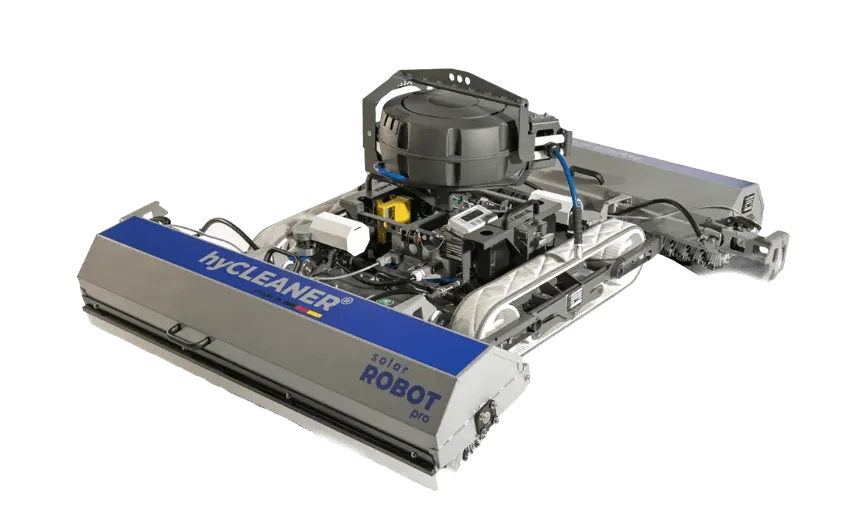
solarROBOT pro
For medium-sized commercial and ground-mounted systems. With a working width of up to 2 meters and semi-automated operation, the solarROBOT Pro is ideal for efficient cleaning of larger module areas.
solarROBOT ultimate
For large-scale systems and ground-mounted projects. With a working width of 2.4 meters, maintenance-free chain drive and high area performance, the solarROBOT Ultimate was developed for professional use on large PV systems.
solarBRUSH 600
The handheld cleaning solution for special constructions, complex roof geometries and professional cleaning service providers. Ideal for applications where cleaning robots cannot be used due to the design.

For agricultural as well as small and medium rooftop systems up to approx. 200 kWp. The cleaning robot can be used independently by the system operator and is supplied including a charging station. CE-certified and developed specifically for cost-effective in-house operation.
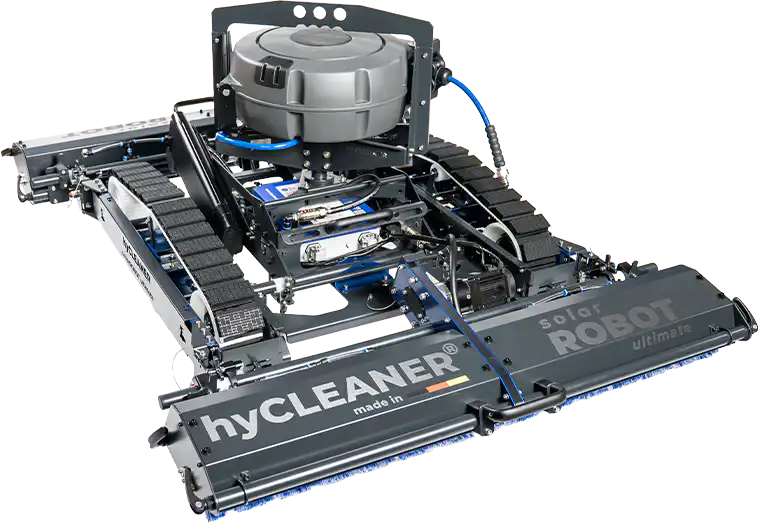
For large-scale systems and ground-mounted projects. With a working width of 2.4 meters, maintenance-free chain drive and high area performance, the solarROBOT Ultimate was developed for professional use on large PV systems.
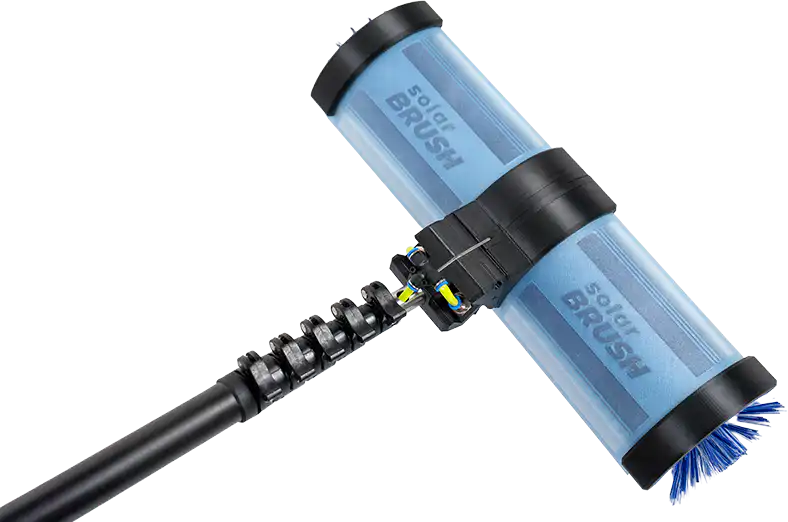
The handheld cleaning solution for special constructions, complex roof geometries and professional cleaning service providers. Ideal for applications where cleaning robots cannot be used due to the design.
All systems clean without chemicals or soap using pure water and enable gentle, material-friendly cleaning of PV systems.
We analyze your system portfolio, calculate your individual cleaning needs and recommend the economically optimal cleaning concept—from a single system to a multi-site park.
That depends on system type, location and degree of soiling. While an individual profitability calculation is recommended for smaller systems, professional cleaning is already economically sensible after a short time for many agricultural, commercial and large ground-mounted systems.
No. Rain mainly removes loose dust particles. Stubborn soiling such as bird droppings, ammonia deposits, lichens or baked-on dust crusts often remain permanently stuck to the modules and can significantly reduce energy yield.
The optimal cleaning interval depends on location, roof pitch and surrounding conditions. Agricultural systems often benefit from two cleanings per year, while for commercial and ground-mounted systems the individual soiling situation is decisive.
Yes. Heavy soiling can promote local shading and thus cause so-called hotspots. These lead to increased temperatures in individual solar cells and can impair the performance and service life of the modules in the long term.
Documented cleaning and maintenance measures create transparency about the system condition and can serve as proof of regular maintenance in the context of servicing, operator duties or in the event of an insurance claim.
Josha Kneiber is Managing Director of hyCLEANER and, together with Celina Kneiber, is responsible for the company’s strategic direction in the field of robot-assisted cleaning systems for PV, glass and facade surfaces. The content is based on many years of industry experience, technical expertise and insights from the day-to-day use of hyCLEANER systems in industry, agriculture and ground-mounted projects.
Calculate your individual yield loss with the hyCLEANER solar loss calculator.
We recommend the economically right cleaning concept for your system.
Why is it worth entering PV cleaning? Growing market, recurring revenues, and scalable business models through modern robotic technology.
How much does a dirty solar system cost? Example calculations for agriculture, commercial roofs and ground-mounted systems – incl. yield losses and cleaning intervals.
Photovoltaic expert Pascal Kierstein explains the most common defects in commercial PV systems and shows how operators can prevent damage.