Why is it worth entering PV cleaning? Growing market, recurring revenues, and scalable business models through modern robotic technology.

Startseite ❯ Solar-Fachartikel ❯ Expert Knowledge ❯ Growing PV Cleaning Industry: Why the Market Offers Attractive Business Opportunities
Enter PV Cleaning Now
Market Opportunities for Founders and Cleaning Companies
Photovoltaics has been booming for years – but while public discussion almost exclusively revolves around module prices, storage, and feed-in tariffs, the majority overlooks a market that is growing in the slipstream of the solar boom: the professional cleaning of photovoltaic systems. Those who enter or expand into this business today will find a rare combination of steadily growing demand, recurring revenues, and a market still far from saturation. This article uses current market figures to show why PV cleaning will be one of the most attractive niches in the renewable energy sector in 2026.
The most important reason why entering PV cleaning is worthwhile is trivial yet crucial: Every day, new solar capacity comes online in Germany – and every new system is a potential new customer.
By mid-2026, approximately 127 gigawatts of photovoltaic capacity were installed in Germany across over 6.1 million systems. In the past twelve months alone, more than 17 gigawatts of new capacity were added – which corresponds to several thousand new systems per week, from private rooftops to solar farms. In the first half of 2026, about nine percent more was installed than in the same period last year. The expansion is not only high, but it is accelerating again.
For cleaning companies, this means that their customer base does not grow linearly with their own sales efforts, but automatically with each newly connected system – regardless of whether they are actively acquiring new clients or not. A market with inherent tailwinds is a rare luxury for a service business.
Unlike many services related to solar systems, PV cleaning is not a project that ends after installation – it only truly begins afterward. Dust, pollen, bird droppings, agricultural and road traffic emissions, and lichen formation continuously accumulate on the modules. This so-called soiling effect is not an exception but a physical reality for every ground-mounted or rooftop system.
The International Energy Agency (IEA) quantifies average annual yield losses due to soiling at 3 to 7 percent, depending on the study and location – with documented power losses of 15 to 30 percent for highly exposed systems near industrial or agricultural areas.
Specialist companies therefore recommend professional cleaning every one to two years, depending on the location, and often annually for flat-roof, agricultural, and industrial systems.
The result for providers: Every acquired customer is not a one-off job, but the beginning of a recurring business relationship. Cleaning intervals can be contractually fixed, maintenance contracts combined, and revenue per customer accumulates over the entire lifespan of the system – typically 20 to 30 years.
Anyone who understands PV cleaning merely as “window cleaning for solar modules” misunderstands the true value of the offering. For operators – whether homeowners, farmers, or solar farm operators – the photovoltaic system is a capital investment with an amortization calculation spanning decades. Every percentage point of yield loss due to soiling is a direct, measurable financial damage.
A professional cleaning provider sees itself not merely as a service provider, but as a solution partner for securing the yield and preserving the value of the PV system. This positioning changes the entire sales argument:
Instead of “We clean your modules,” the message is:
“We secure your electricity yield and the value of your system over its entire lifespan.”
Cleaning costs often amortize within one year if the self-consumption rate and degree of soiling are high enough.
For commercial operators, cleaning costs are also regularly tax-deductible as operating expenses; for private households, they are partially deductible as household-related services.
This role as a yield partner instead of a mere cleaning company is the decisive lever to differentiate oneself from competitors, justify higher prices, and build long-term service relationships instead of individual contracts.
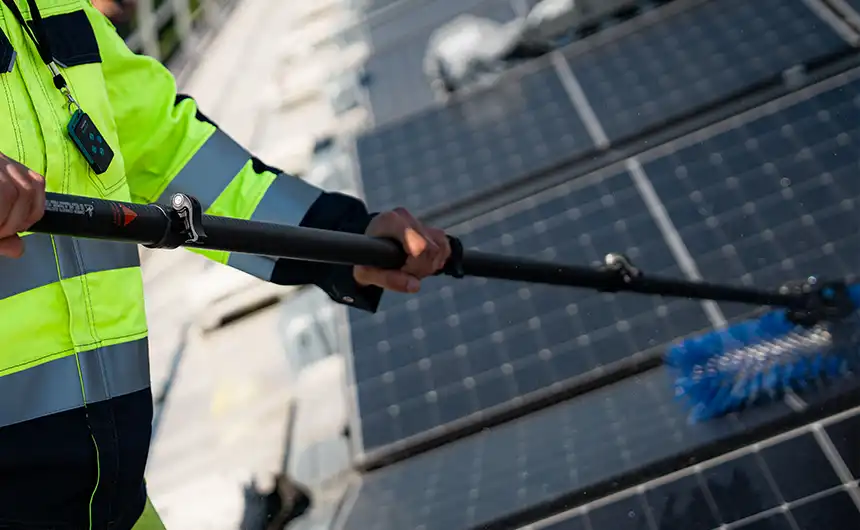
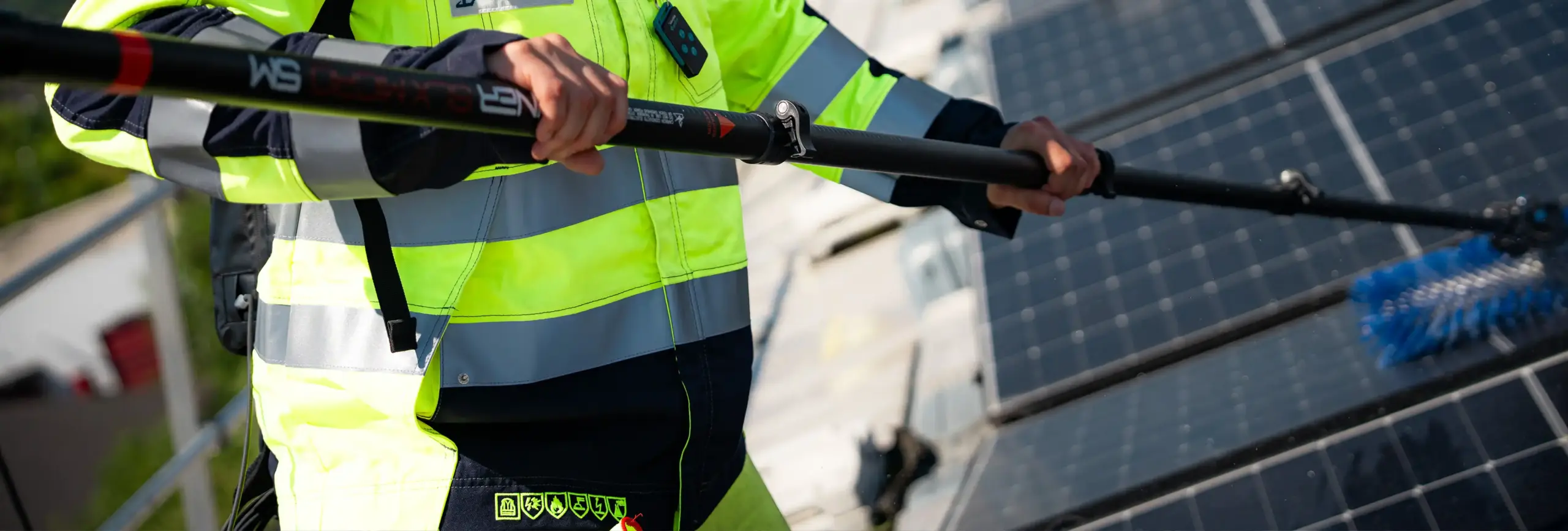
The second major lever lies in technology. Manual cleaning with brushes, water, and ladders is time-consuming, labor-intensive, and risky – the area performance per workday is limited.
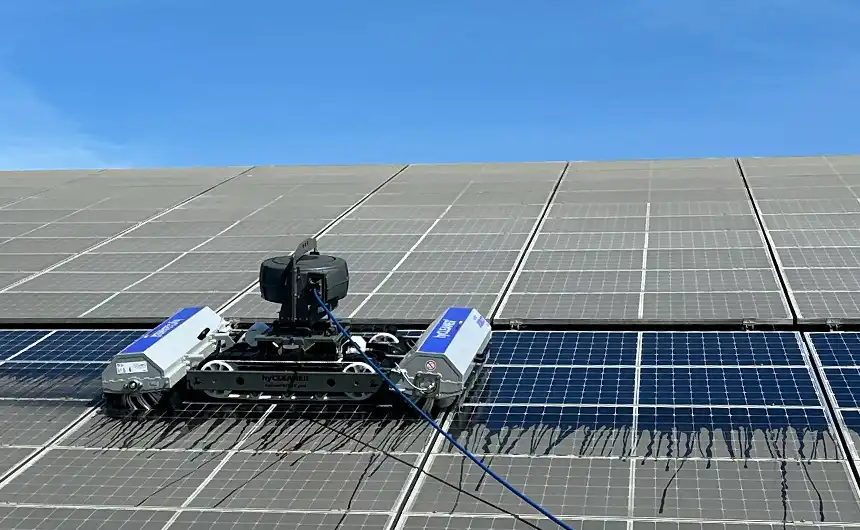
Modern, remote-controlled or semi-autonomous cleaning robots fundamentally change this equation: Large solar farm areas can be cleaned by a single skilled worker with appropriate robotic technology in a fraction of the time that manual teams would require – commercially available systems in the professional segment achieve several hundred to over a thousand square meters of cleaning performance per hour.
For providers, this means that revenue per day of operation scales not with the number of employees, but with the technology used. A single robotic system can process as much area in one day as several manual cleaning teams combined – with lower personnel risk (working at heights, on inclined surfaces) and consistently high, documented cleaning quality.
This is precisely where, for example, the solarROBOT series comes in: From compact entry-level models for rooftop systems to ultimate models for large ground-mounted systems, the fleet size can be scaled precisely to the respective order volume.
Economically, this means: Where traditional service companies reach the limits of their personnel capacity, robot-assisted providers can increase their daily revenue through additional machines instead of additional personnel – a significantly more attractive scaling model.
“Robotic technology enables cleaning companies to process larger PV areas with less personnel. This not only makes cleaning more efficient but also significantly improves the scalability of the business model.”
Josha Kneiber, Geschäftsführer hyCLEANER
Perhaps the most compelling point for entering now: The market penetration of professional PV cleaning is still low – measured by the number of installed systems – while the overall market is growing strongly.
Market analyses estimate the global solar cleaning market at approximately 1.2 to 1.3 billion US dollars in 2025, with growth forecasts of 7 to 14 percent annually into the 2030s – depending on the study, a market volume of 2.5 to over 4.5 billion US dollars is expected by 2034/2035. The specific segment of cleaning systems and robots is growing even faster than the overall solar energy market itself, with double-digit rates in some cases.
At the same time, market reality shows: A large proportion of Germany’s over 6 million PV systems are not regularly professionally cleaned. For classic inclined residential roofs, rain often handles part of the cleaning; however, for flat-roof systems, agricultural businesses, commercial properties, and especially ground-mounted solar farms, professional cleaning is often still the exception rather than the rule, even though the economic benefit is greatest here.
It is precisely in these segments – agriculture, commercial, solar farms – that growth in Germany is currently particularly strong, with an estimated untapped potential of over 35 gigawatts for commercial rooftop areas alone.
In short: The supply of professional, high-quality cleaning services still lags significantly behind the number of installed systems. Those who position themselves today with modern robotic technology, a clear stance as a yield partner, and a business model designed for recurrence will encounter growing demand with comparatively little established, highly professional competition.
The PV cleaning industry combines four characteristics that are individually attractive – but together create an exceptionally robust business model:
Combined with a market that, despite double-digit global growth rates, is still far from saturation, a rarely clear picture emerges: The PV cleaning industry is not at the end, but only at the beginning of its actual growth phase.
Would you like to professionally enter PV cleaning or further develop your existing cleaning business? We advise you on suitable cleaning solutions and support you in selecting the right equipment.
Calculate your individual yield loss with the hyCLEANER solar loss calculator.
We recommend the economically right cleaning concept for your system.
Why is it worth entering PV cleaning? Growing market, recurring revenues, and scalable business models through modern robotic technology.
How much does a dirty solar system cost? Example calculations for agriculture, commercial roofs and ground-mounted systems – incl. yield losses and cleaning intervals.
Photovoltaic expert Pascal Kierstein explains the most common defects in commercial PV systems and shows how operators can prevent damage.