Which PV brush width ensures maximum efficiency?
- Expert Knowledge
Why PV brush width is crucial for cleaning equipment
PV brush width significantly determines how efficiently and thoroughly you clean your solar system. At the same time, it directly influences the surface performance and the quality of the cleaning. In this article, you will therefore learn which brush width is best suited for your system and how to make your cleaning more efficient. Further technical details and background information can be found in our specialist article “The perfect PV cleaning device – The right solution for your solar surface“.
How does PV brush width affect cleaning performance in practice?
PV brush width determines how efficiently, evenly, and with how much control you clean your system.
With the right brush width, you not only clean large areas faster but also maintain the necessary precision. Furthermore, you improve control over the brush and reduce the physical effort required. If, on the other hand, you choose a brush that is too wide, you lose control more quickly and have to use more force. If the brush is too narrow, you increase the time required because you have to perform more cleaning passes.
Only when you optimally coordinate working width and handling will you achieve a uniform cleaning result with minimal effort. Especially with different types of systems, it becomes clear how much the brush width influences your efficiency.
Problem: Incorrect PV brush width leads to inefficient cleaning and increased workload
If you choose the wrong PV brush width, you not only lose time but also reduce the cleaning quality.
If the brush is too narrow, you have to clean significantly more lanes to cover the entire module area. This not only increases the time required but also the physical strain, as more movements are necessary. Especially with larger systems, this additional effort adds up considerably and thus directly affects the cost-effectiveness of the cleaning.
If, however, the brush is too wide, you lose control, especially on rooftop systems, edge areas, or angled surfaces. This increases the risk of areas being cleaned unevenly or even missed. In addition, the greater weight and stronger leverage increase the physical effort, making handling more difficult and further reducing precision.
In practice, an unsuitable brush width often means you have to compromise between speed and quality – resulting in neither efficiency nor cleaning results being optimal.
Solution: The right PV brush width increases efficiency and ensures uniform cleaning results
By choosing the right PV brush width, you clean not only more efficiently but also with significantly more control and consistently high quality.
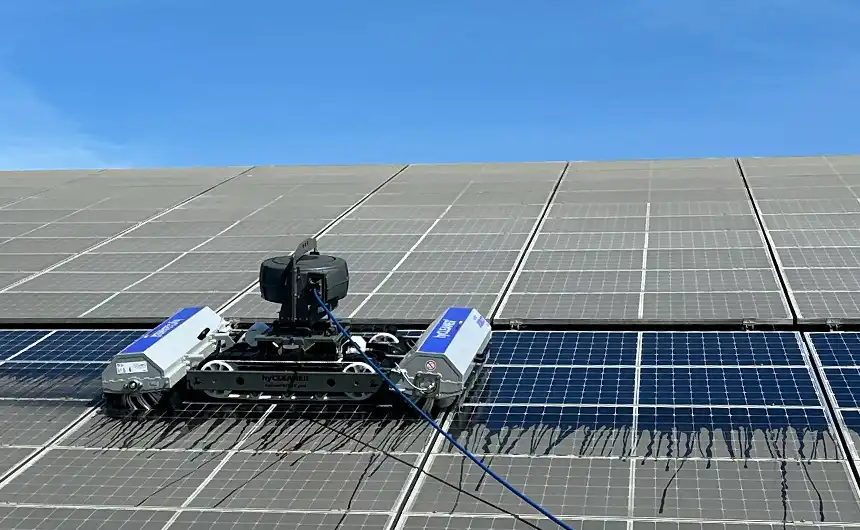
Tailor the brush width specifically to your system and the respective application. On large and easily accessible areas such as solar parks or industrial roofs, you work significantly faster with wide brushes, as you cover more area per pass and thus considerably reduce the total working time.
For smaller or complex systems, however, you benefit from narrower brushes, as you can guide them more precisely along module frames, edge areas, and hard-to-reach spots. This avoids missed areas and achieves a uniform cleaning result.
If you also use flexible or modular systems, you can vary the brush width depending on the application and thus efficiently clean different types of systems. In this way, you combine high surface performance with optimal control.
In practice, this means: By selecting the brush width specifically, you not only shorten cleaning times but also increase quality and reduce physical effort.
What are the advantages of different PV brush widths?
Brush width
Typical benefit
Narrow brush
Enables precise work and maximum control, especially for small or angled rooftop systems
Medium brush
Offers a balanced combination of efficiency and handling and can be used flexibly for different types of solar systems
Wide brush
Maximizes surface performance while saving time, especially for large and easily accessible systems