Why is it worth entering PV cleaning? Growing market, recurring revenues, and scalable business models through modern robotic technology.

Startseite ❯ Solar-Fachartikel ❯ Expert Knowledge ❯ Which photovoltaic cleaning kit do I need for professional PV cleaning?
Getting started in PV cleaning
For building cleaners and aspiring PV cleaning professionals
This is the question almost everyone asks at the beginning. The answer is simpler than you might think: tap water contains limescale and minerals. When these dry on a warm solar module, white deposits remain – so-called limescale spots. They reduce light incidence just like dust or bird droppings.
There is also a second effect: limescale-containing water practically attracts new dirt after cleaning. The module surface becomes rougher and dust adheres more easily. In the worst case, using tap water does more harm than good.
The solution is pure water – fully demineralized water that evaporates without residue after cleaning, taking the dirt with it. It is produced on site with a reverse osmosis system. The quality value professionals measure: TDS below 15 ppm.
"Professional solar cleaning uses demineralized pure water (TDS < 15 ppm) produced with a reverse osmosis system. Tap water leaves limescale spots and accelerates dirt buildup on PV modules."
Josha Kneiber, Geschäftsführer hyCLEANER
A reverse osmosis system (RO system or osmosis system) filters tap water through a special membrane and removes dissolved salts, limescale and minerals. The result is fully demineralized pure water. Which system is suitable depends on the area size and team size.
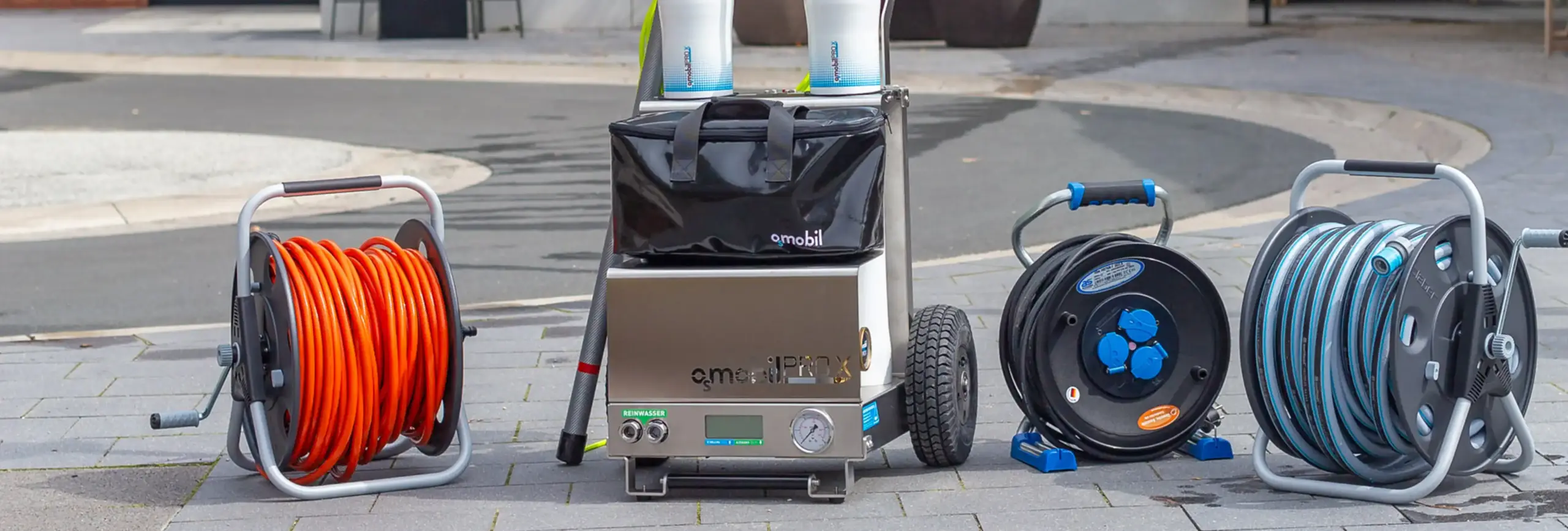
OSMOBIL ONE / OSMOBIL PRO X
The OSMOBIL ONE X is the classic entry-level option for solo operators: compact, straightforward, and can be run from any 230 V outlet. The OSMOBIL PRO X delivers up to 410 liters of pure water per hour and is the basis of the proven professional set. Ideal for one or two employees on rooftop systems and smaller ground-mounted systems.
Up to 410 l/h • 230 V standard operation • compact & mobile
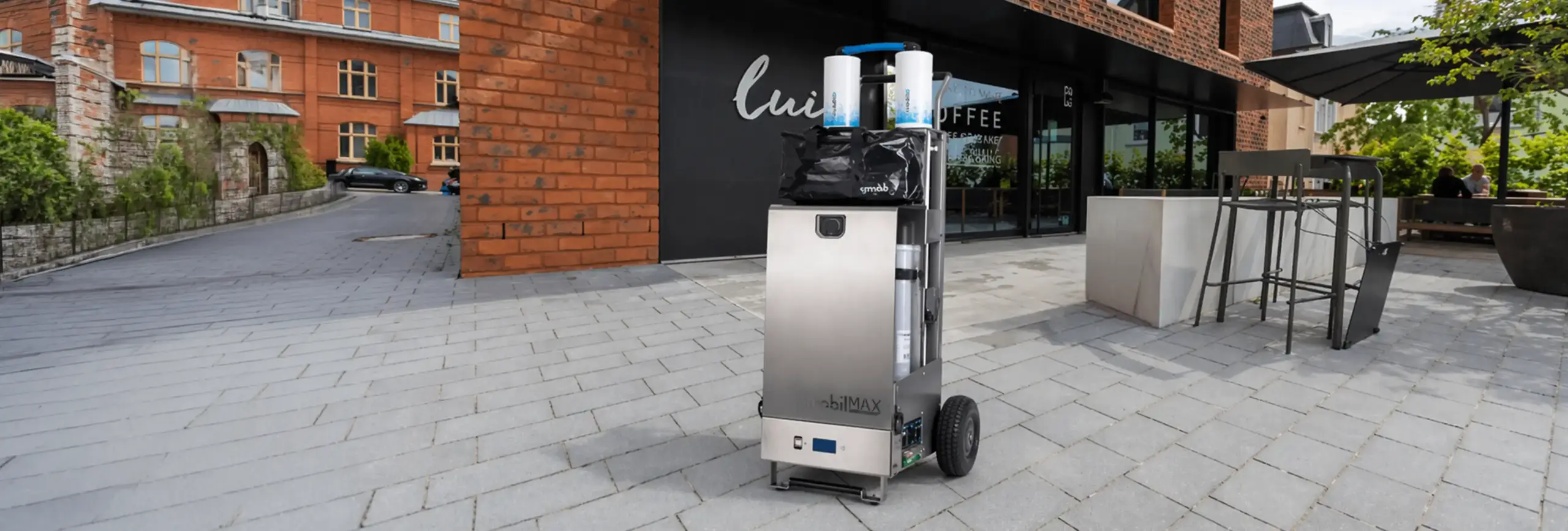
OSMOBIL MAX
Anyone who regularly cleans larger solar parks, uses robots, or wants to deploy several employees at the same time cannot do without the OSMOBIL MAX. It delivers up to 750 liters of pure water per hour, has three separate outlets for operating three devices simultaneously, and functions as a fully mobile pure-water tank station independent of an on-site water connection. As the first system in the OSMOBIL series, it is connected to the OSMOBIL Cloud: GPS location tracking, water quality monitoring, and remote access to all operating data via an integrated, speed-controlled pump.
Up to 750 l/h • 3 outlets simultaneously • cloud monitoring (GPS + TDS) • mobile tank station • 230 V standard operation
Yes – and it is far more than a stopgap. Many professional cleaners who work on rooftop systems every day still rely on manual pole systems. They are lightweight, ready to use immediately, and do not require high upfront investment.
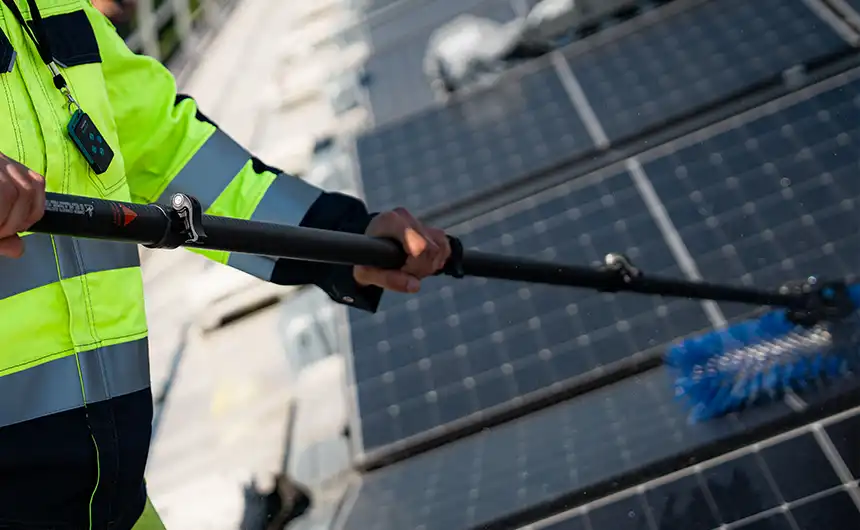
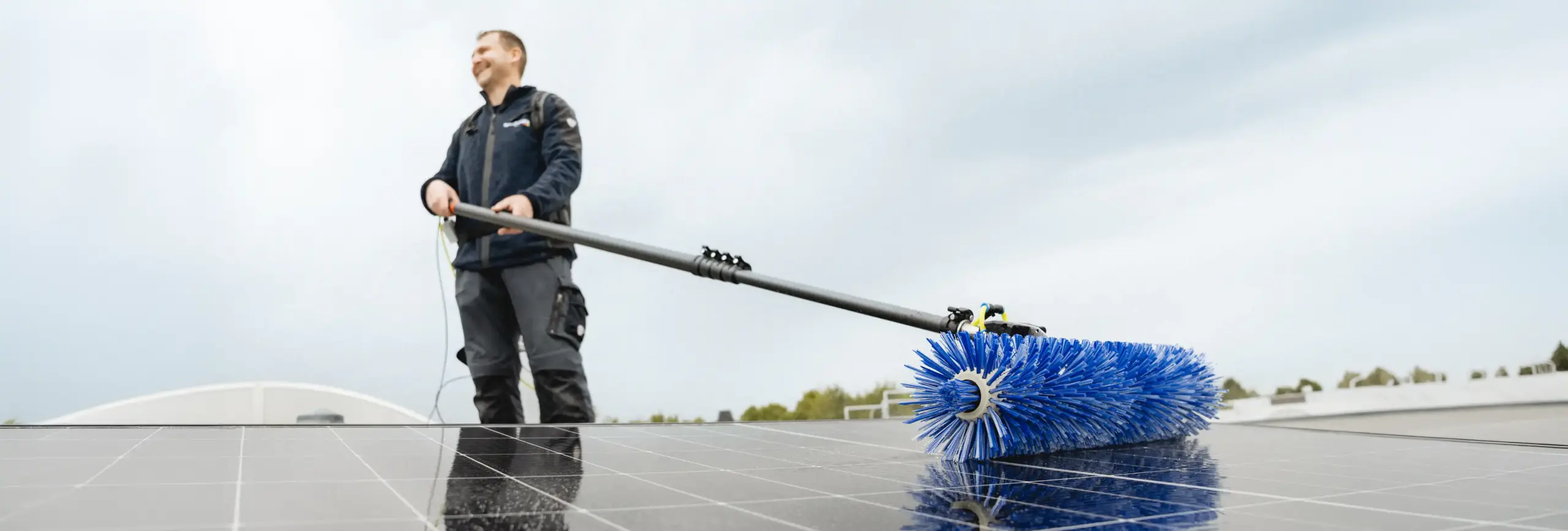
However, the difference between a simple pole and a professional system is significant. Effective solar cleaning requires a water-fed carbon pole that delivers pure water directly to the brush head and can be guided in a controlled manner even at heights of 12 to 15 meters.
“For manual solar cleaning, a water-fed carbon telescopic pole (e.g., GARDINER Super MAX) with a solar cleaning brush and osmosis water supply is recommended. Working heights of up to 17 meters can be reached without a ladder or lift.”
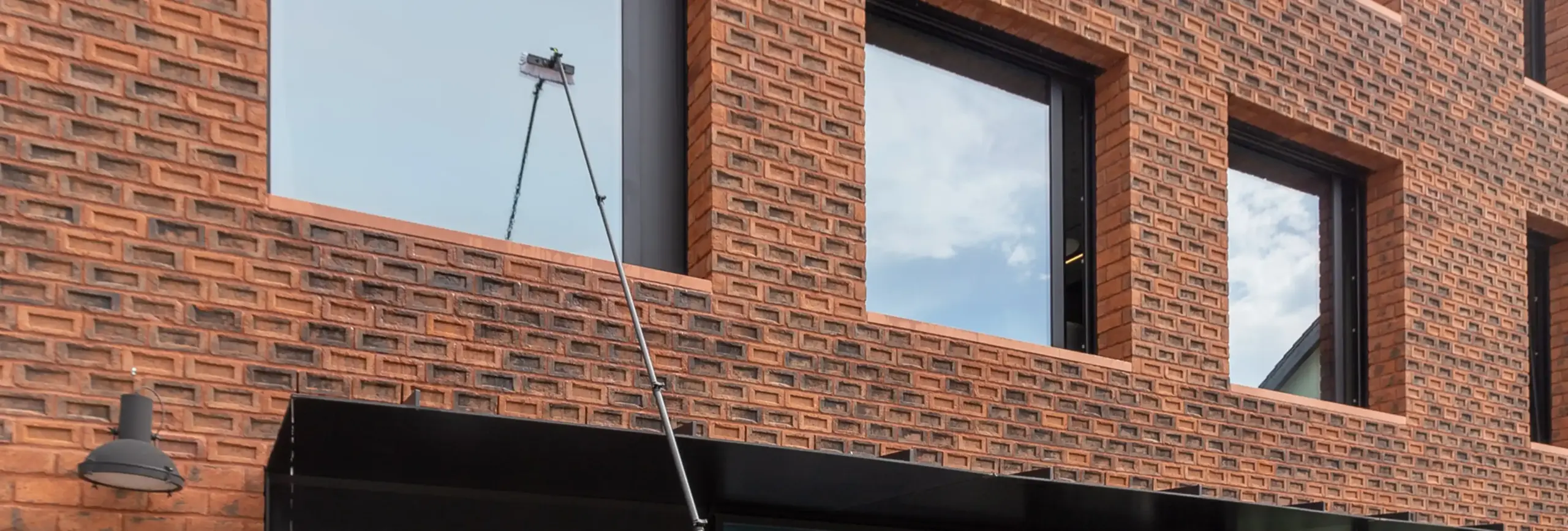
Carbon pole system + solar cleaning brush
Professional carbon pole systems made from high-quality 3K carbon fiber are designed for cleaning work at greater heights. Depending on the model, they offer compact transport dimensions of under two meters and extended reaches of up to 15 meters – with working heights of up to approx. 16.8 meters and low dead weight at the same time.
Such systems are often complemented by specially developed cleaning brushes with, for example, a 45 cm working width and soft bristles, which are particularly suitable for sensitive glass surfaces.
Larger variants can even enable working heights of up to almost 20 meters. Many systems are modular in design and intended for professional applications.
Lightweight • telescopic • modular • designed for great working heights
As soon as areas of around 200 m² are cleaned regularly or there is soiling that requires too much force with a normal brush, rotating systems are used. These systems also work faster, more evenly, and significantly reduce strain on the operator’s shoulders.
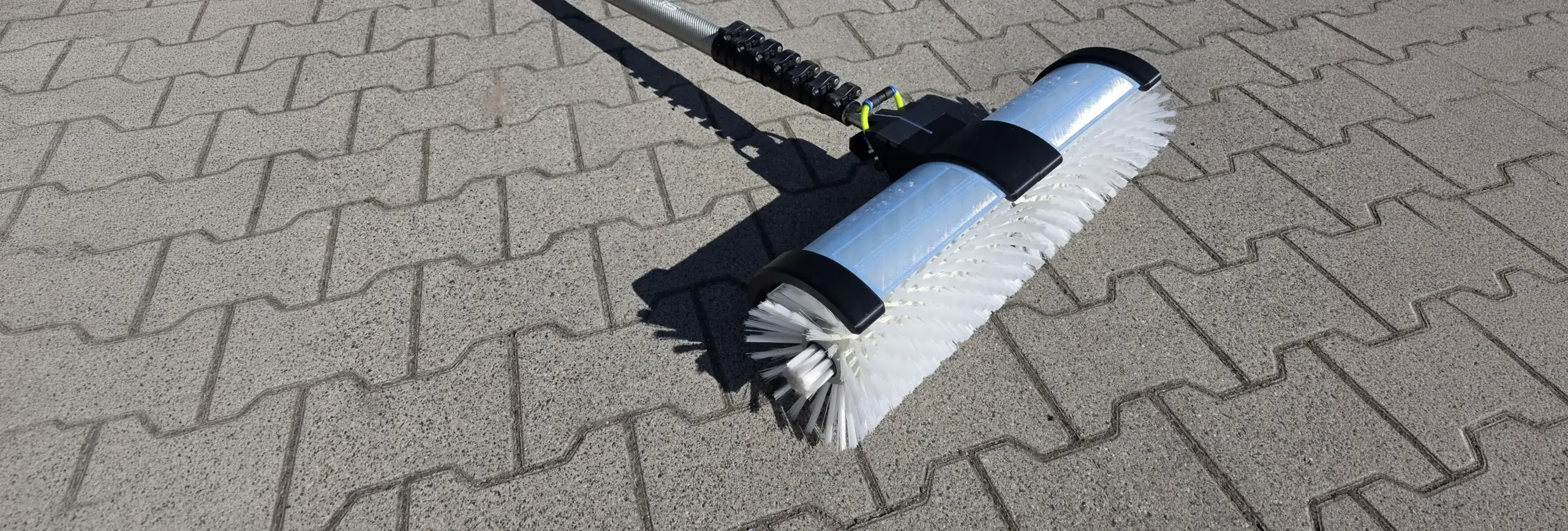
Rotating brush
Rotating cleaning solutions are designed for professional manual use when cleaning larger areas. With working widths of, for example, 600 mm, some systems are based on a battery-powered drive concept and are intended to offer a lighter alternative to comparable hydro-driven solutions. This eliminates the need for pressure washers and heavy hose systems. At the same time, low water consumption is intended, which can also make the use of compact water solutions possible. In combination with a carbon pole and a mobile water filtration system, some models can achieve area performance of up to approx. 250 m² per hour. In addition, working heights of up to almost 17 meters can be reached without a ladder.
»A solar cleaning robot pays off from around 2,000 m² per deployment. For regular ground-mounted systems, a robot often pays for itself in the first cleaning season.«
At hyCLEANER there are exactly two levels: a true entry-level option that is not overwhelming and not overpriced – and a professional model that grows with the business.
The honest answer: From regular areas of around 2,000 m² per deployment. Below that, the setup time – unloading, assembling and positioning the robot – is often too high in relation to the labor time saved.
However, anyone who serves a customer base with ground-mounted systems or larger rooftop systems on an ongoing basis quickly realizes: with two people and one robot, you can clean in one hour the area that used to take half a day with manual pole systems. That fundamentally changes the calculation.
Rule of thumb: Below 2,000 m² per deployment, a manual system is sufficient. From around 2,000 m² with regular deployments, a robot pays off, often already in the first season.
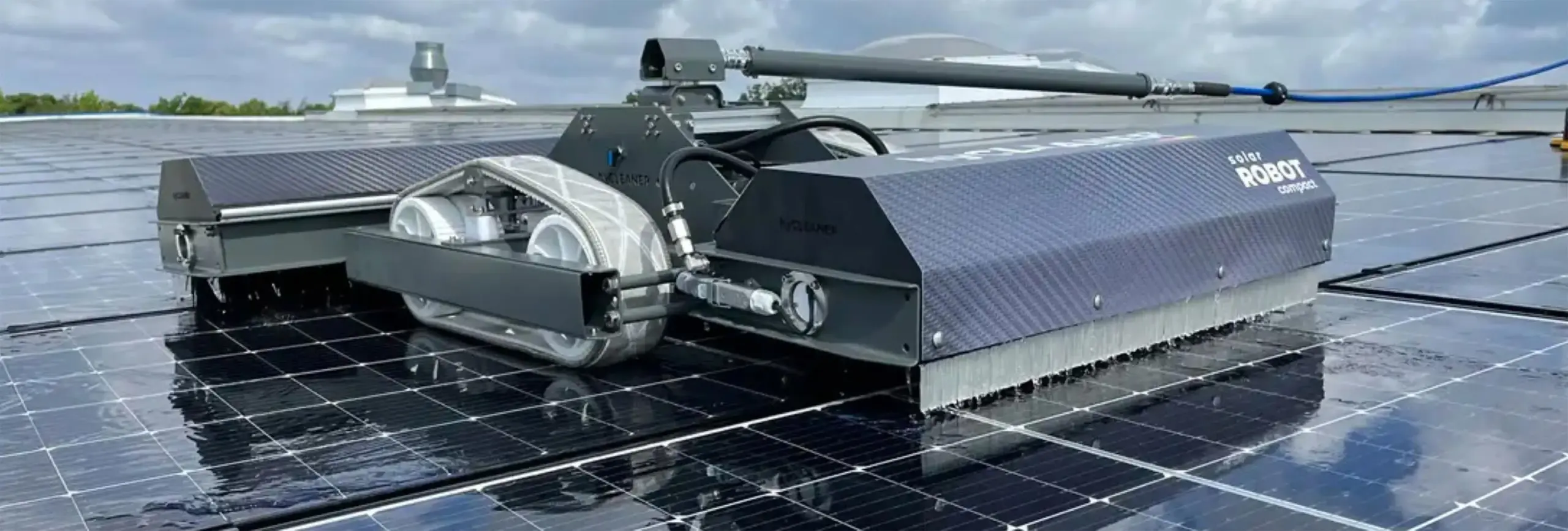
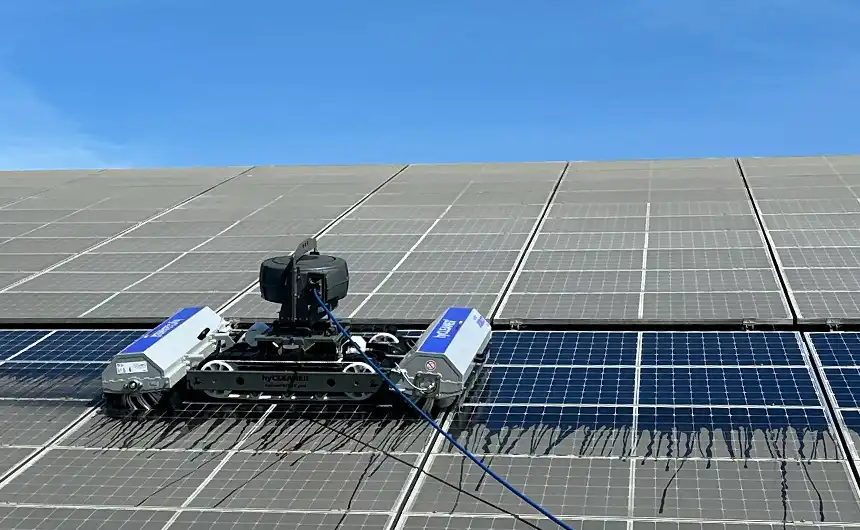
hyCLEANER solarROBOT compact
The solarROBOT compact was developed as an entry point into automated solar cleaning without immediately requiring a high investment budget. With an entry price below €22,000 net, it is among the most affordable cleaning robots manufactured in Germany and is also a fully fledged work tool.
The system can be broken down into six components, none of which weighs more than 10 kg. This makes it possible to use it on almost any roof surface without a crane or lift. Two 800 mm roller brushes clean twice in a single pass and, in offset configuration, achieve a working width of up to 1,100 mm. Optional edge detection with automatic stop is one of the relevant safety features in this device category.
Below €22,000 net • up to 1,100 m²/h • incline up to 25° • Made in Germany • battery 1.5–2 h • optional edge detection
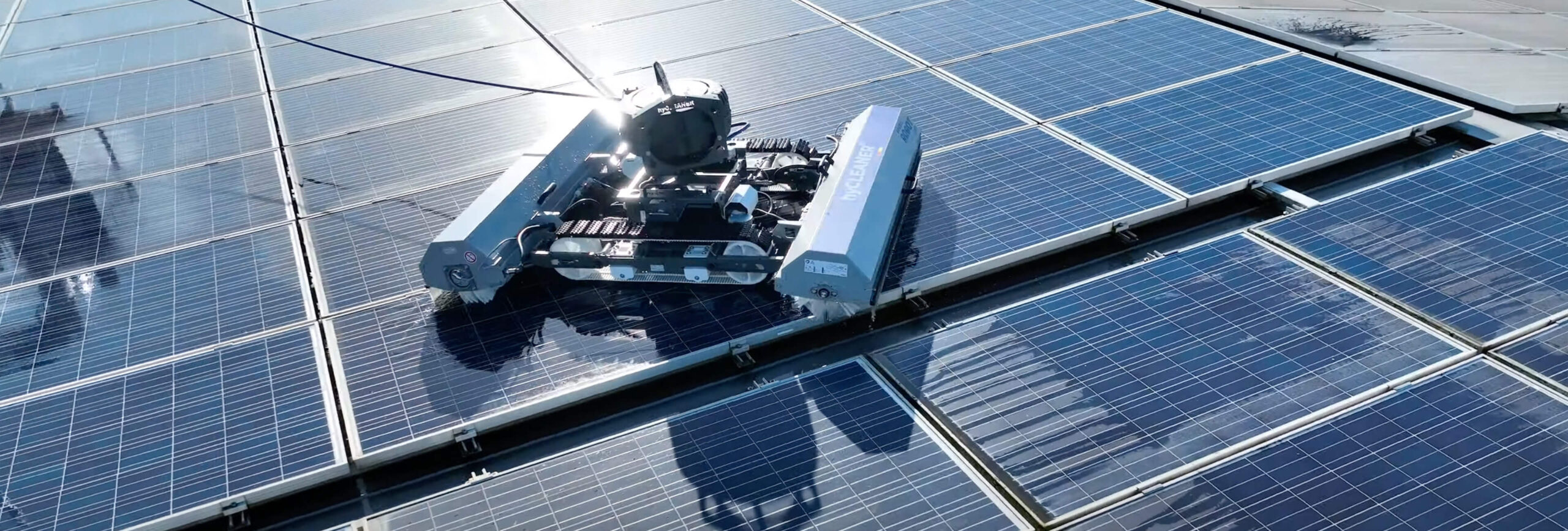
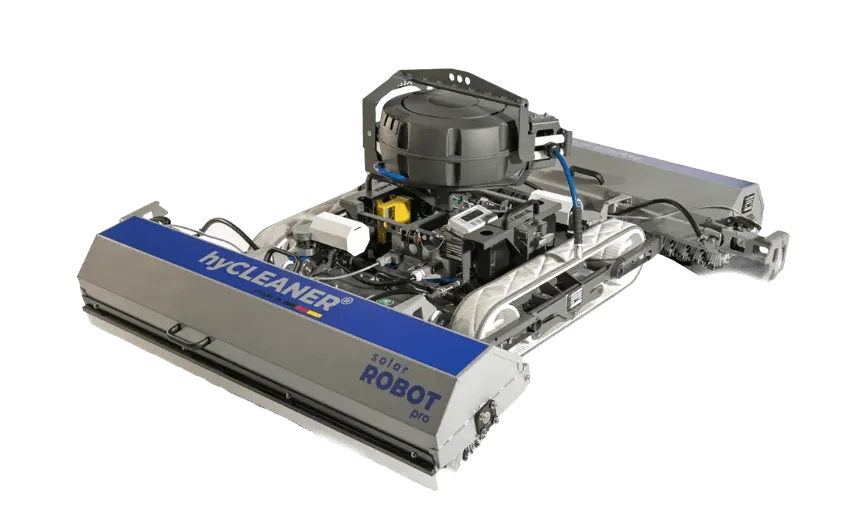
hyCLEANER solarROBOT pro
The professional model for growing cleaning businesses Areas from 2,000 m² Rooftop systems and ground-mounted systems
The solarROBOT pro is the professional model for businesses that regularly clean large areas. Brush width 1,100 mm as standard, expandable in offset configuration to 2,400 mm, resulting in a maximum area performance of 2,400 m² per hour.
AutoDrive is standard equipment. The robot keeps its track independently and stops at edges; the operator steers, with no need for constant focus on the remote control. With optional side guidance, the solarROBOT pro can be used on ground-mounted systems with inclines of up to 47 degrees.
The DIRT FORCE lichen remover attachment is directly compatible.
Up to 2,400 m²/h • AutoDrive as standard • incline up to 47° (side guidance) • Made in Germany • battery up to 3 h • compatible with DIRT FORCE lichen remover
For wet cleaning, yes. Limescale-containing tap water would not only leave residues on the modules; in the long term it also impairs the robot’s brushes and hose system.
The solarROBOT pro works directly with the OSMOBIL MAX. Even at full robot utilization, it continuously supplies sufficient pure water without an intermediate tank. The solarROBOT compact works with the OSMOBIL PRO X.
For dry cleaning, for example with a light dust film on ground-mounted systems, no water is required. Both robots can be used dry and wet.
Yes, with limitations that should be taken into account. The solarROBOT compact manages inclines of up to 20 degrees as standard, the solarROBOT pro up to 25 degrees on rooftop systems and up to 47 degrees with optional side guidance on
ground-mounted systems. This covers most ground-mounted systems and elevated flat-roof systems without any issues.
For classic pitched roofs in the 20 to 25 degree range, an on-site demo is recommended. In addition to the incline, the surface condition of the modules is also crucial. Demo appointments can be arranged directly on request.
With a telescopic pole, the OSMOBIL ONE X, and your first local customers. Not because of the budget, but because of the experience. Those who understand what soiling looks like on different systems, what customers expect, and how prices are calculated make investment decisions on a more solid basis. If you plan to purchase a robot in the medium term, you should consider the OSMOBIL PRO X.
The manual setup from VF Reinigungstechnik remains useful even when using a robot, for example for edge areas, tight spaces between modules, and smaller jobs where the setup time of a robot does not pay off.
Whether it’s an agricultural rooftop system, a commercial roof or a large solar park—the economically optimal cleaning solution depends on system size, location and degree of soiling. Together, we analyze your system and recommend the right cleaning concept.
Our cleaning solutions at a glance
solarROBOT compact
For agricultural as well as small and medium rooftop systems up to approx. 200 kWp. The cleaning robot can be used independently by the system operator and is supplied including a charging station. CE-certified and developed specifically for cost-effective in-house operation.
solarROBOT pro
For medium-sized commercial and ground-mounted systems. With a working width of up to 2 meters and semi-automated operation, the solarROBOT Pro is ideal for efficient cleaning of larger module areas.
solarROBOT ultimate
For large-scale systems and ground-mounted projects. With a working width of 2.4 meters, maintenance-free chain drive and high area performance, the solarROBOT Ultimate was developed for professional use on large PV systems.
solarBRUSH 600
The handheld cleaning solution for special constructions, complex roof geometries and professional cleaning service providers. Ideal for applications where cleaning robots cannot be used due to the design.

For agricultural as well as small and medium rooftop systems up to approx. 200 kWp. The cleaning robot can be used independently by the system operator and is supplied including a charging station. CE-certified and developed specifically for cost-effective in-house operation.
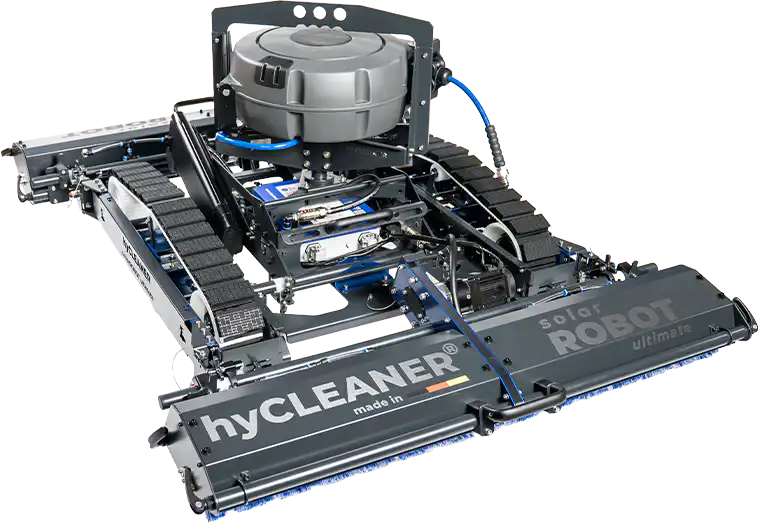
For large-scale systems and ground-mounted projects. With a working width of 2.4 meters, maintenance-free chain drive and high area performance, the solarROBOT Ultimate was developed for professional use on large PV systems.
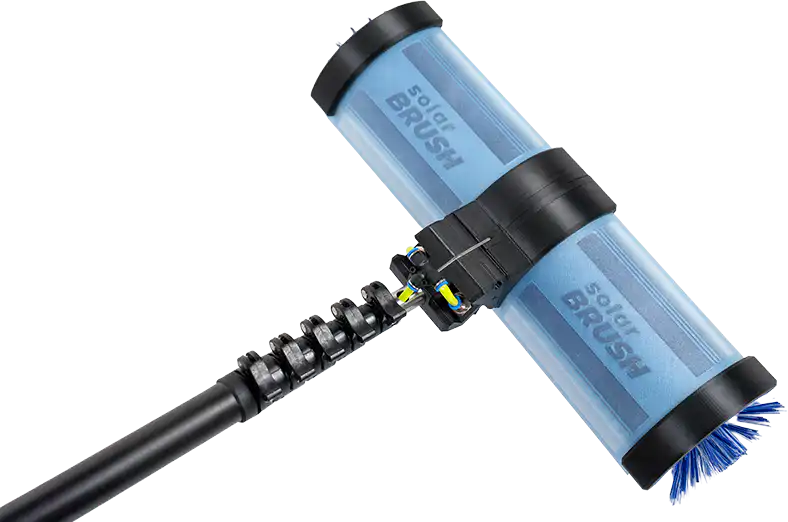
The handheld cleaning solution for special constructions, complex roof geometries and professional cleaning service providers. Ideal for applications where cleaning robots cannot be used due to the design.
All systems clean without chemicals or soap using pure water and enable gentle, material-friendly cleaning of PV systems.
We analyze your system portfolio, calculate your individual cleaning needs and recommend the economically optimal cleaning concept—from a single system to a multi-site park.
That depends on system type, location and degree of soiling. While an individual profitability calculation is recommended for smaller systems, professional cleaning is already economically sensible after a short time for many agricultural, commercial and large ground-mounted systems.
No. Rain mainly removes loose dust particles. Stubborn soiling such as bird droppings, ammonia deposits, lichens or baked-on dust crusts often remain permanently stuck to the modules and can significantly reduce energy yield.
The optimal cleaning interval depends on location, roof pitch and surrounding conditions. Agricultural systems often benefit from two cleanings per year, while for commercial and ground-mounted systems the individual soiling situation is decisive.
Yes. Heavy soiling can promote local shading and thus cause so-called hotspots. These lead to increased temperatures in individual solar cells and can impair the performance and service life of the modules in the long term.
Documented cleaning and maintenance measures create transparency about the system condition and can serve as proof of regular maintenance in the context of servicing, operator duties or in the event of an insurance claim.
Calculate your individual yield loss with the hyCLEANER solar loss calculator.
We recommend the economically right cleaning concept for your system.
Why is it worth entering PV cleaning? Growing market, recurring revenues, and scalable business models through modern robotic technology.
How much does a dirty solar system cost? Example calculations for agriculture, commercial roofs and ground-mounted systems – incl. yield losses and cleaning intervals.
Photovoltaic expert Pascal Kierstein explains the most common defects in commercial PV systems and shows how operators can prevent damage.