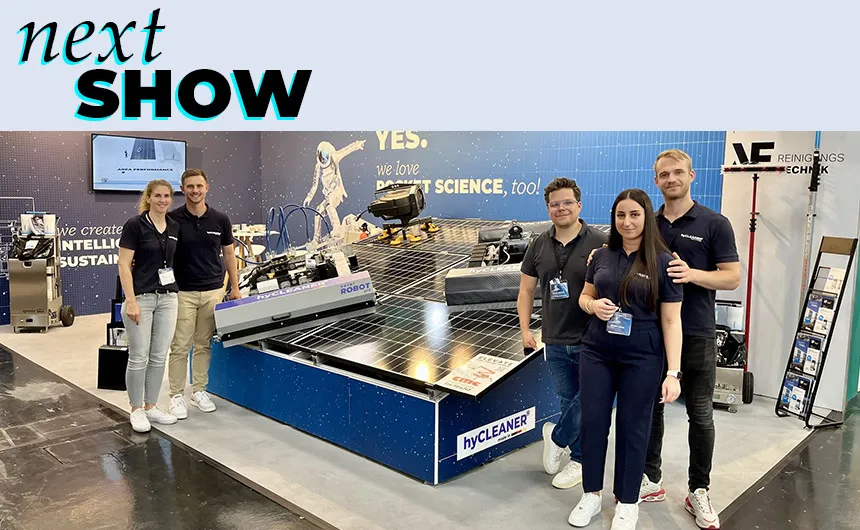

*we are at the CMS in Berlin: 23.- 26.09.25 / outdoor area booth 106/108*

Photovoltaic cleaning brushes: How technology and bristle design determine the performance of PV cleaning robots

Precisely matched photovoltaic cleaning brushes are crucial for cleaning photovoltaic modules. They achieve a high cleaning performance with minimal wear, protect the sensitive module surface and ensure thorough PV cleaning. Modern cleaning robots rely on special brush systems that are perfectly matched to the material, diameter and rotation speed. Anyone considering the purchase of a PV cleaning brush often asks themselves: Do different types of brushes need to be used for optimum results? Do you also need to use cleaning agents? In this article, you will find out which technical parameters are decisive for achieving the best results with a photovoltaic cleaning brush - whether rotating or stationary.

Rotational and circumferential speed - the clock generator for cleaning

A key factor for the performance of PV cleaning is the rotational speed (rpm - "rounds per minute"), which has a direct impact on the mechanical effect. Equally important is the peripheral speed (m/s), as it describes the actual relative movement of the bristles to the module surface.

A peripheral speed that is too high can accelerate bristle wear and even cause micro-damage, while a speed that is too low significantly reduces the cleaning effect. A balanced setting is therefore crucial: lower speeds are preferable for sensitive surfaces or fine work, while higher speeds are more efficient for robust surfaces.

In practice, 300 rpm for the solarROBOT compact and 400 rpm for the solarROBOT pro have proven to be ideal for PV cleaning robots, as they ensure both efficiency and gentle solar cleaning.

Brush diameter - more surface area, more effect

The brush diameter also has a major influence on cleaning performance. A larger diameter increases the peripheral speed at the same speed and ensures better surface coverage. At the same time, however, the weight increases and with it the energy requirement.

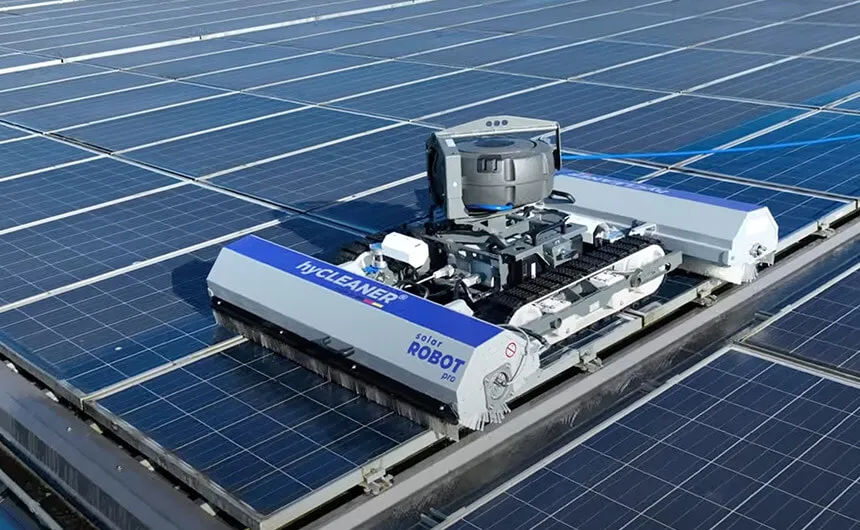
In pv panel cleaning, typical brush diameters are between 150 mm and 300 mm - depending on the drive system and module configuration. In high-quality systems, a combination of high rotation and large diameter is deliberately chosen in order to thoroughly remove even stubborn dirt. For example, the large PV cleaning robot solarROBOT pro has a diameter of 300 mm and even its smaller brother compact has a diameter of 280 mm.

Bristle type and material - the heart of pv panel cleaning brushes

The material of the bristles is decisive for the performance of a PV cleaning brush. These are frequently used:

  • Polyamide (PA): high elasticity, good abrasion resistance
  • Polypropylene (PP): cost-effective, resistant to chemicals
  • Natural fibers (e.g. horsehair): for sensitive surfaces

✔️ The choice of bristle material should always depend on the degree of soiling, the module coating and the ambient conditions.

Bristles - finely tuned for even performance and self-cleaning

Not only the material as such, but also the arrangement, thickness and length of the bristles influence the cleaning performance.

Tight vs. loose - tight increases the contact surface, loose improves dirt pick-up.

Helix/spiral shape - even results, good self-cleaning, prevents dirt deposits, ideal for uneven or sloping surfaces.

Segmented - targeted dirt removal through higher point loading.

Thick and long - different bristle thicknesses enable a combination of abrasive and gentle cleaning. Homogeneous bristle fields ensure even loading and make maintenance easier.

Photovoltaic cleaning brushes: Tips for PV cleaning robots
Example of a helix/spiral brush

Frequently asked questions about PV cleaning brushes

One brush type for all requirements?

Whether several types of brushes are needed for PV cleaning is a question of philosophy. Some rely on special brushes, others on all-rounders. The latter offer the advantage that they deliver consistently good results on different surfaces thanks to the optimum combination of bristle type, arrangement, diameter and rotation speed - without being too hard or too soft.

Brush bearing - floating for even contact

The mounting of the photovoltaic cleaning brush is also an important aspect. With floating photovoltaic cleaning brushes, the brush does not stand directly on the bristles, but is suspended in such a way that it glides easily over the surface. This design makes it possible to combine a large brush diameter and fast rotation, which results in more bristle tip contact and a more even cleaning effect. Systems with a stationary brush, on the other hand, often have to use smaller diameters, which reduces the area coverage.

Water spray lance - in front of or in the brush?

Another distinguishing feature of PV cleaning brushes is the position of the water spray lance.

  • Under a splash guard - water is sprayed directly onto the bristles, aiding cleaning and keeping the bristles clean. Splash guard prevents dirt from getting back onto the solar modules.
  • Before the brush - water is first applied to the surface, then the bristles clean. For sandy dirt, a higher water supply is necessary to avoid sanding effects.

Direction of rotation of PV cleaning brushes - flexible, but with care

The direction of rotation also plays a role. As standard, many brushes rotate outwards against the direction of travel so that dirt particles are effectively bound in the water and discharged downwards.

It is possible to switch to co-rotation, but this can result in more dirt being thrown onto the appliance. This can cause the treadmills to become dirty more quickly and reduce grip. In such cases, it is advisable to check the edge sensors regularly.

Conclusion: Optimal pv panel cleaning brushes for cleaning robots

The optimum pv panel cleaning brush combines the right brush diameter, the right speed, the right bristle material and a well thought-out arrangement with an effective water flow. Efficient, gentle and sustainable cleaning of solar modules is only possible if all these factors work together harmoniously.

If you are unsure, you should carry out a PV cleaning brush test before purchasing or seek advice directly from the manufacturer. When buying a cleaning robot, it is worth taking a closer look at the brush system installed, as it has a significant influence on the cleaning results.

Video on the brush design for PV cleaning robots
🎥 Our video tip on brush design: Watch the Instagram video

Find out more about effective and gentle cleaning methods and our innovative solutions for pv panel cleaning - we will be happy to advise you personally!

hyCleaner logo in white with Made in Germany labelhyCleaner we Create
intelligent solutions for sustainable surfaces.
Address
Maybachstr. 6
48599Gronau, Germany
Technical support
+49 2562 99254 20
© Copyright 2025 hyCLEANER GmbH & Co. KG | All rights reserved.
created by Pocket Rocket
envelopephone handsetmagnifiercrossmenuchevron-down