PV Cleaning with Cleaning Drone
Limitations & Alternatives in Industrial Use
What is PV Cleaning with Drones – and Why is it Gaining Attention?
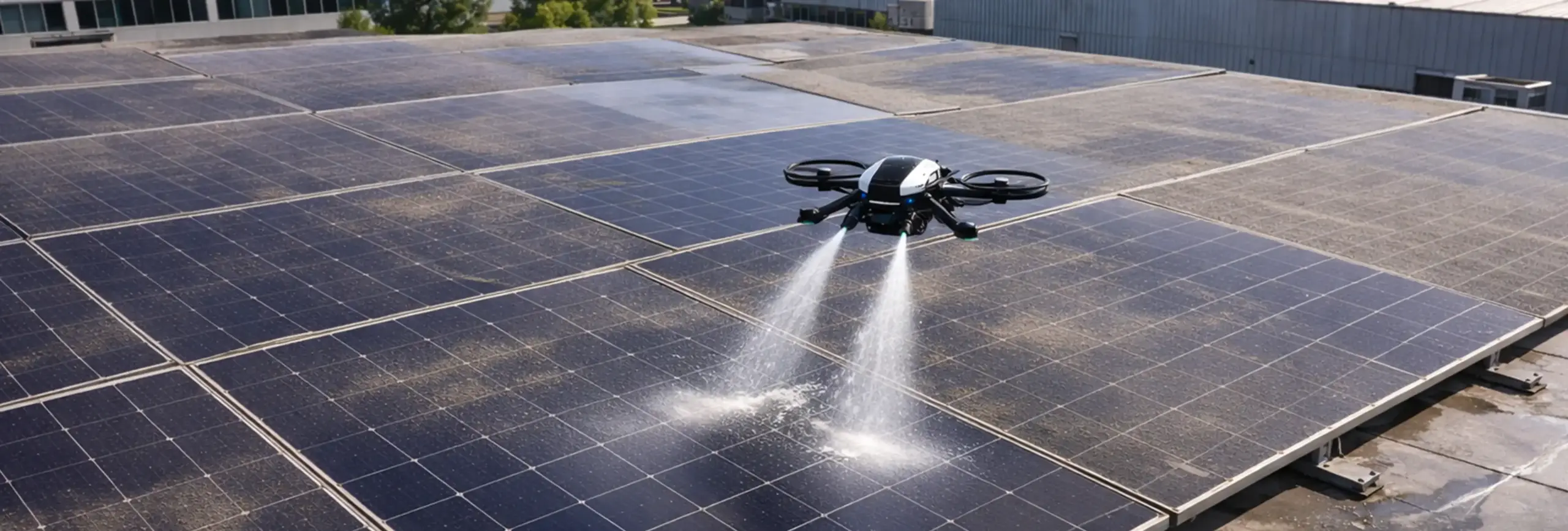
PV cleaning with drones involves specially equipped multicopters that apply water or cleaning fluid to the modules via a spray system – contact-free and from the air.
The technology has been actively marketed since approximately 2022–2024 and promises lower personnel costs, elimination of lift platforms, and quick operations even on hard-to-reach systems. Providers such as PrecisionFly, Sky Cleaning or CopterClean report capacities of up to 600 m² per hour.
Despite high media attention, a closer look reveals significant limitations – especially on an industrial scale.
How Does Solar Cleaning with Drones Work Technically?
In the spray method, the cleaning drone flies at a constant distance over the module surfaces and distributes water – usually softened or as osmosis water – through nozzles. Sometimes thermal cameras (e.g., DJI Zenmuse H20T) are used beforehand to identify soiled or defective areas and plan the cleaning precisely.
Some research prototypes – for example, from Sung Kyun Kwan University in Seoul – also rely on mechanical contact: the drone lands on the module and cleans with rotating brushes. However, these approaches are complex, maintenance-intensive, and not yet market-ready for large systems.
Why is a Pure Spray Cleaning Not Sufficient?
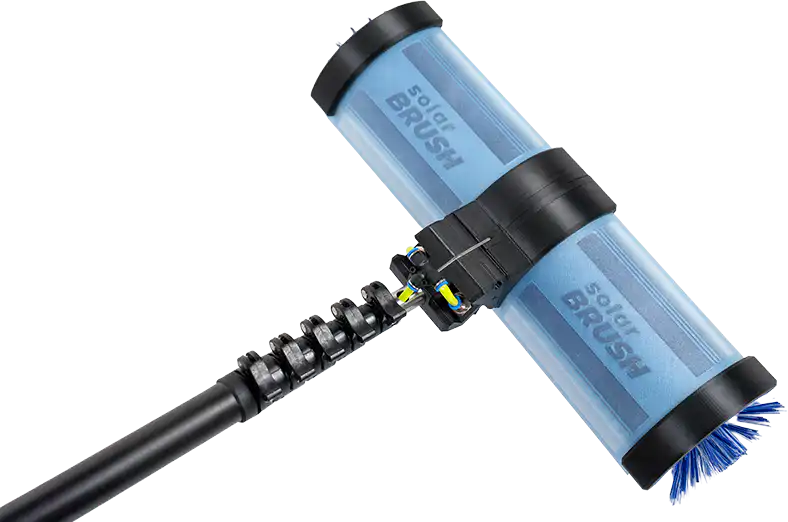
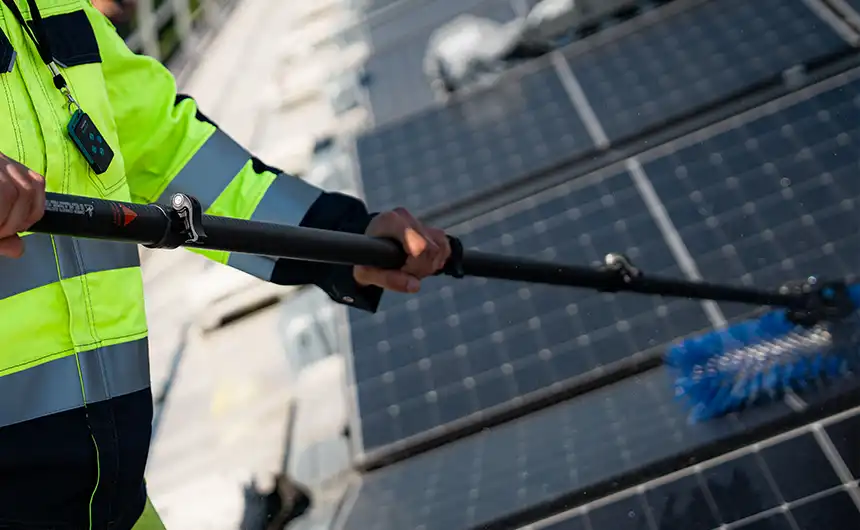
Typical contaminants such as fine dust, soot, pollen, bird droppings, or biofilm adhere mechanically to the glass surface. Water alone – even under pressure – does not reliably remove these residues. Only direct brush contact generates the necessary shear force for a complete cleaning.
The effect is comparable to a soaked pan: without mechanical assistance, residues remain. For PV modules, this leads to residual contamination, hot spots, and persistent yield losses.
Core Problem
Without mechanical cleaning, no reproducible, complete result is achieved.
What Risks Arise from High-Pressure Use in Drone Cleaning?
To compensate for the lack of mechanics, higher pressure is often used. However, this cannot be constantly controlled from the air: fluctuations in distance, wind, and drone movements lead to uneven impact pressure.
Possible consequences include damage to anti-reflective coatings, leaks, and micro-cracks in the glass. Such defects often only become apparent later through performance losses or electrical problems. Furthermore, the manufacturer’s warranty may be void if non-certified procedures are used.
Risk
Variable pressure from the air represents an underestimated potential for damage to modern high-performance modules.
Why is the Use of Chemicals in Drone Cleaning an Environmental Problem?
Under certain conditions, drone cleaning can be useful – for example, for small, private rooftop systems with light soiling in dry regions. There, it serves as a supplementary interim solution, but not as a complete replacement.
A clear advantage, however, lies in inspection: thermography and visual analyses can be carried out efficiently from the air and provide valuable condition data.
For larger systems – especially from approximately 500 kWp – drone cleaning is neither technically nor economically competitive.
For Which Types of Systems is Drone Cleaning at Best Useful?
Drone cleaning can contribute under very specific conditions – namely for smaller, private rooftop systems with light dust contamination in dry regions without industrial fine dust input. Here, periodic wet cleaning by spray drone can supplement cleaning – as an interim solution, not as a replacement.
Also, drone inspection (thermography, image documentation) is a valid and valuable application area: hot spots, defective strings, or contamination profiles can be efficiently mapped from the air – without the need for actual cleaning performance.
For solar farms from 500 kWp, industrial rooftop systems, and open-field systems with regular cleaning requirements, drone cleaning is not economically or technically competitive.
Comparison: Cleaning Drones vs. Cleaning Robots
Drone Cleaning:
contactless, no complete cleaning, wind-dependent, limited flight time (approx. 10–20 minutes), often requires chemical use, restricted operating conditions in rain and wind
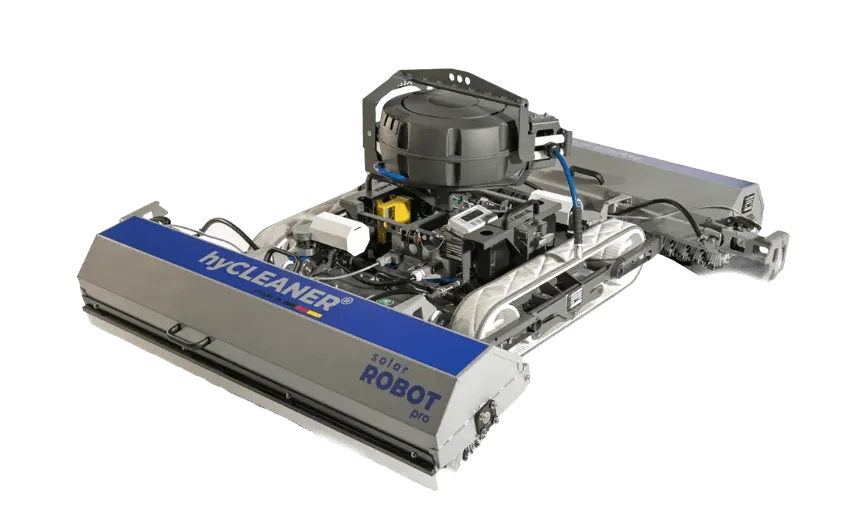
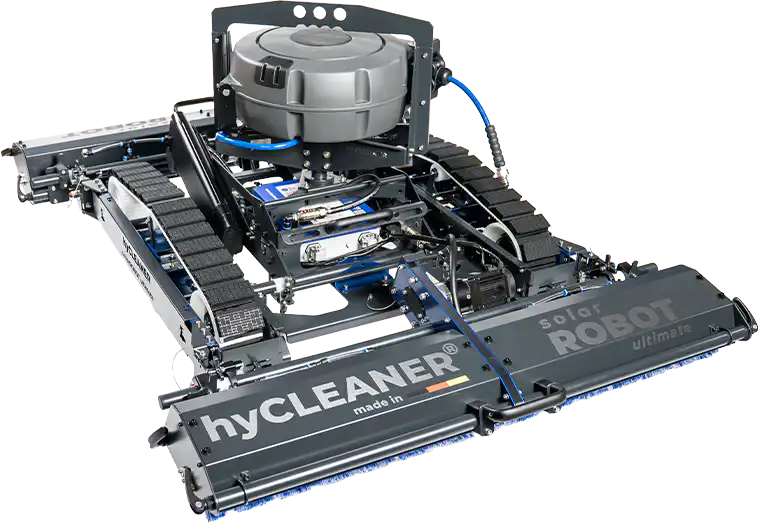
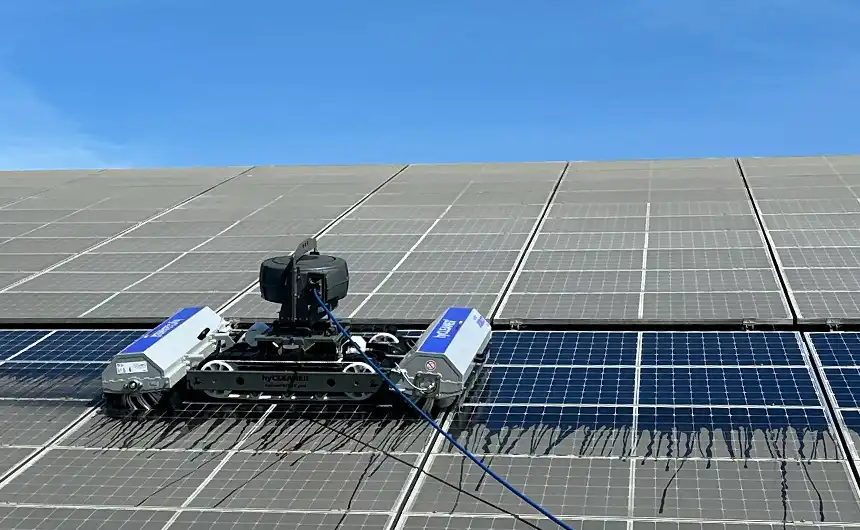
Cleaning Robots (e.g., solarROBOT Pro): mechanical brush contact, reproducible results, scalable, high area performance, low noise, weather-independent and chemical-free operation
In industrial use, cleaning robots deliver measurably better and more stable results.
What are the Economic Disadvantages of Drone Cleaning for Large-Scale Systems?
For a solar farm with 5 MWp and rather 1 kWp, approximately 5 sqm = approx. 12,000 m² of module surface means a drone with 600 m²/h theoretically requires 20 hours of cleaning time – given good weather, full battery, no wind, and uncritical obstacles. Realistically, significantly longer times are needed due to battery changes, wind breaks, and refilling.
Cleaning robots can work with multiple units simultaneously, cover consistently large areas, and do not require specialized pilot personnel. The Total Cost of Ownership (TCO) over 3–5 years is significantly lower for robot-assisted cleaning of large-scale systems – especially if multiple cleaning cycles per year are required.
Additionally, residual contamination negatively impacts yield (typically 1–8%), further reducing the economic viability of the drone solution.
Conclusion for Professional PV Operators
Cleaning drones are already a valuable tool for inspection and analysis. However, as a cleaning solution for industrial PV systems, they are technically limited and economically inferior.
For solar farms and large rooftop systems, mechanical cleaning with robot systems remains the superior solution: reliable, scalable, chemical-free, and with proven increased yield.
hyCLEANER GmbH & Co. KG develops corresponding systems in Germany – including solarROBOT Pro, solarROBOT compact, and solarROBOT Ultimate.
In short:
Drone for inspection – robot for cleaning.
This represents the current state of the art for industrial PV systems.
This is the state of the art for industrial PV systems.
DO YOU HAVE FURTHER QUESTIONS?
Please feel free to send us a message; we will get back to you promptly.
*Required field