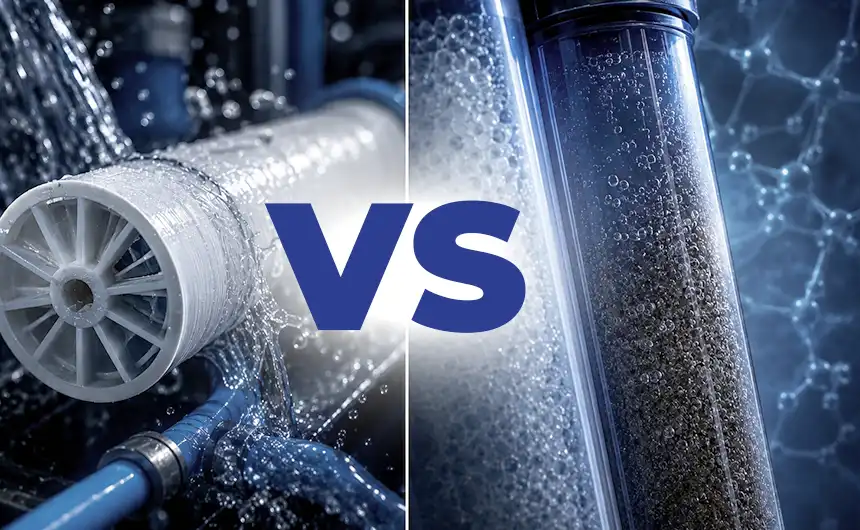
Water quality significantly influences the success of osmosis cleaning. Learn about the role of ppm values and water hardness.



Startseite ❯ Solar-Fachartikel ❯ Expert Knowledge ❯ Reverse Osmosis vs. Mixed Bed Resin – Which Solution Is More Economical?
For professional cleaning of PV systems, glass surfaces, and facades, water quality is critical. Only mineral-free pure water enables residue-free cleaning and long-term cleanliness of surfaces.
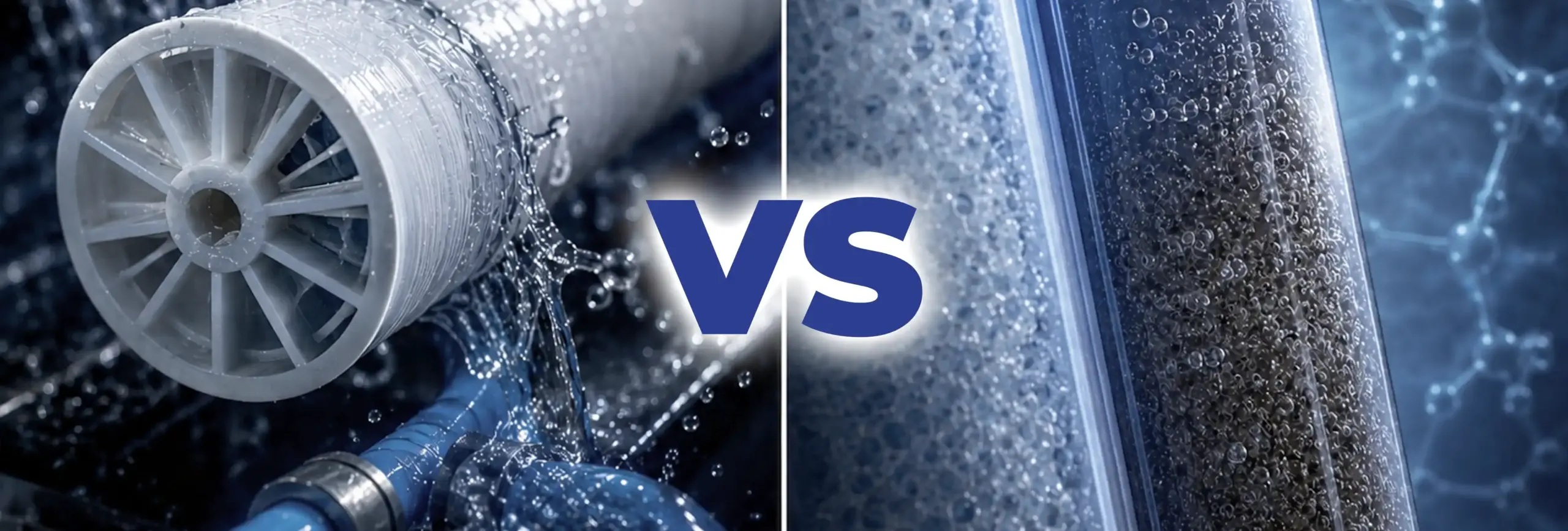
Two main methods are used to produce this pure water:
Both systems pursue the same goal but differ significantly in:
Particularly for professional cleaning companies, the choice of system determines long-term efficiency and profitability.
In reverse osmosis, tap water is pressed through a special membrane under pressure. This retains:
The result is nearly mineral-free pure water for professional cleaning.
Mixed bed resin filters remove minerals from water using special resins. The contained resins bind the unwanted substances from the tap water. Once the capacity is exhausted, the resin must be replaced. This creates regular ongoing costs.
Water quality directly influences the economic efficiency of the systems.
In regions with hard water, mixed bed resin filters consume their capacity significantly faster. This considerably increases operating costs.
Reverse osmosis systems, on the other hand, operate significantly more consistently and economically.
The following values are recommended for professional cleaning results:
The lower the ppm value, the more residue-free the surface dries.
For regular cleaning contracts, reverse osmosis systems offer significant long-term advantages. Companies benefit from:
Mixed bed resin filters are mainly suitable for:
For professional cleaning companies, reverse osmosis is the more economical solution in the long term. Particularly for large PV systems, facades, and glass surfaces, companies benefit from low operating costs and high efficiency.
Mixed bed resin filters can be useful for smaller and infrequent applications, but quickly reach economic limits with regular use.
Whether it’s an agricultural rooftop system, a commercial roof or a large solar park—the economically optimal cleaning solution depends on system size, location and degree of soiling. Together, we analyze your system and recommend the right cleaning concept.
Our cleaning solutions at a glance
solarROBOT compact
For agricultural as well as small and medium rooftop systems up to approx. 200 kWp. The cleaning robot can be used independently by the system operator and is supplied including a charging station. CE-certified and developed specifically for cost-effective in-house operation.
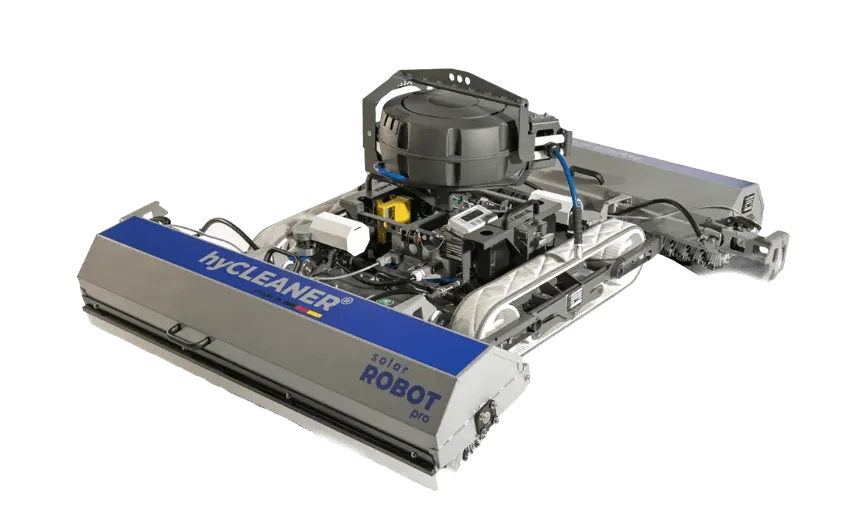
solarROBOT pro
For medium-sized commercial and ground-mounted systems. With a working width of up to 2 meters and semi-automated operation, the solarROBOT Pro is ideal for efficient cleaning of larger module areas.
solarROBOT ultimate
For large-scale systems and ground-mounted projects. With a working width of 2.4 meters, maintenance-free chain drive and high area performance, the solarROBOT Ultimate was developed for professional use on large PV systems.
solarBRUSH 600
The handheld cleaning solution for special constructions, complex roof geometries and professional cleaning service providers. Ideal for applications where cleaning robots cannot be used due to the design.

For agricultural as well as small and medium rooftop systems up to approx. 200 kWp. The cleaning robot can be used independently by the system operator and is supplied including a charging station. CE-certified and developed specifically for cost-effective in-house operation.
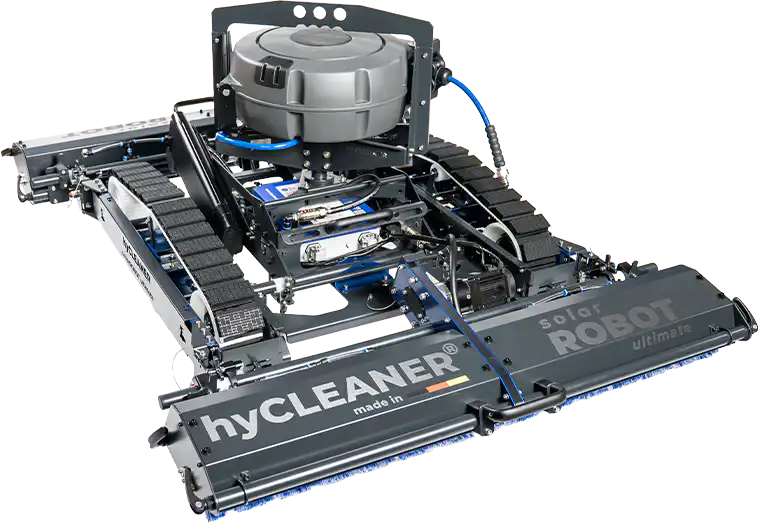
For large-scale systems and ground-mounted projects. With a working width of 2.4 meters, maintenance-free chain drive and high area performance, the solarROBOT Ultimate was developed for professional use on large PV systems.
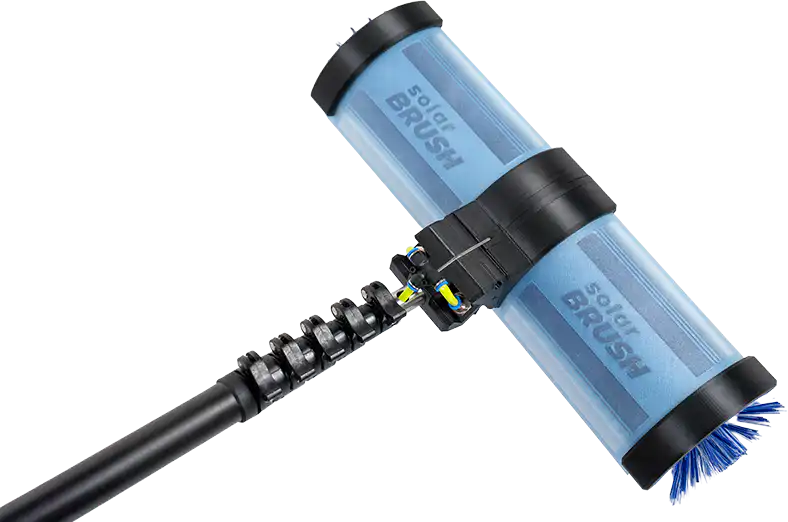
The handheld cleaning solution for special constructions, complex roof geometries and professional cleaning service providers. Ideal for applications where cleaning robots cannot be used due to the design.
All systems clean without chemicals or soap using pure water and enable gentle, material-friendly cleaning of PV systems.
We analyze your system portfolio, calculate your individual cleaning needs and recommend the economically optimal cleaning concept—from a single system to a multi-site park.
Even light soiling can cause a 5–20% drop in performance—on large systems, that can quickly amount to several thousand euros per year.
Calculate your loss here.
As soon as there is a measurable loss of yield or visible soiling. For commercial systems, cleaning often pays off after just one season.
Generally every 12–24 months. In dust-intensive regions or in agriculture/industry, often more frequently.
Yes—especially for rooftop systems. Fall risk, module breakage, and liability issues make professional methods advisable.
Depending on size and soiling, usually between €2–€6 per square meter
Robots move autonomously over the modules, brush the surface, and use water or dry methods—consistently and gently on materials.
Calculate your individual yield loss with the hyCLEANER solar loss calculator.
We recommend the economically right cleaning concept for your system.
Water quality significantly influences the success of osmosis cleaning. Learn about the role of ppm values and water hardness.
Reverse osmosis or mixed bed resin? Find out which pure water system is more economical in the long term for PV and facade cleaning.
Osmosis Cleaning in Industry – how do cleaning companies and businesses benefit from it? Learn why this technology ensures efficient, residue-free results and saves costs.