Why is it worth entering PV cleaning? Growing market, recurring revenues, and scalable business models through modern robotic technology.



Startseite ❯ Solar-Fachartikel ❯ Expert Knowledge ❯ Osmosis Cleaning in Industry
Osmosis cleaning has established itself as a particularly efficient and sustainable method in the professional cleaning of photovoltaic systems, glass facades, and industrial surfaces. By using treated pure water, dirt can be thoroughly removed without the need for chemical cleaning agents. Especially for large solar surfaces, facades, and sensitive surfaces, osmosis cleaning offers decisive advantages in terms of cleaning results, cost-effectiveness, and workplace safety. At the same time, the residue-free cleaning reduces rapid re-soiling and contributes to the long-term preservation of the cleaned surfaces. For building cleaners, PV service providers, and plant operators, osmosis cleaning is therefore increasingly becoming the standard for modern cleaning processes.
Osmosis cleaning uses treated tap water. This normally contains various minerals, limescale and salts. When regular tap water evaporates, these components remain on the surface, for example in the form of limescale spots. Even if these are only very fine residues, they form a slight raised edge where soot particles and dust, for example, can stick. The result: the cleaned surface gets dirty again faster and needs to be cleaned again after a short time.
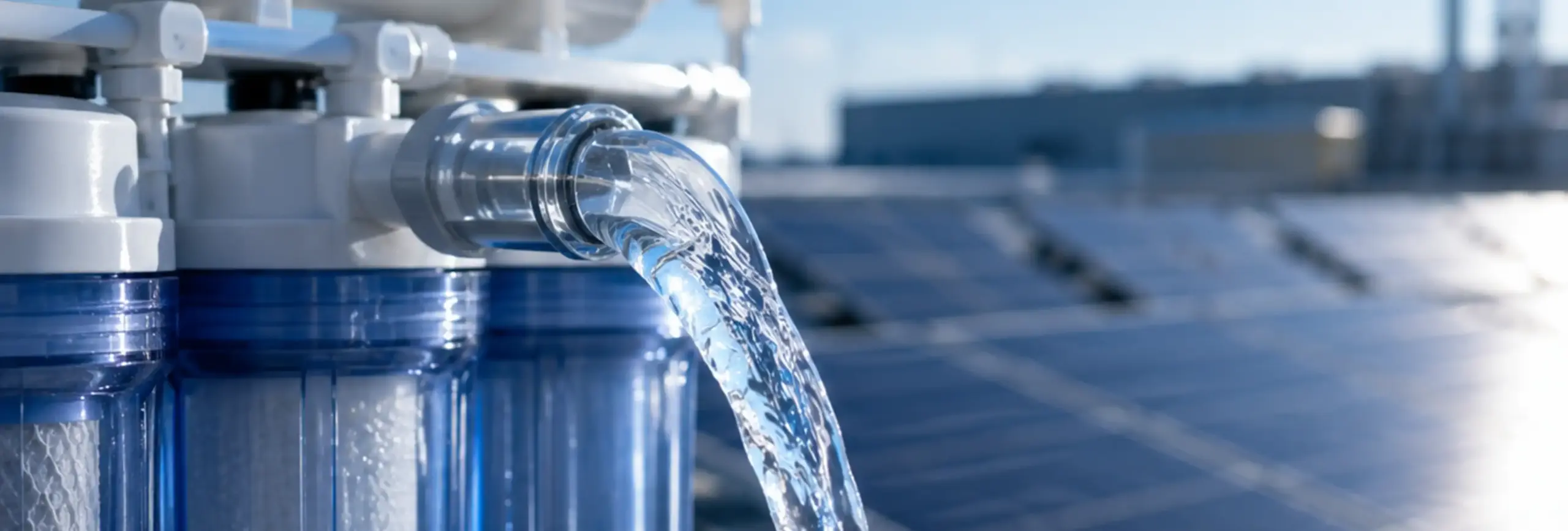
In osmosis cleaning, the water first passes through a special reverse osmosis filtration system, which purifies the water of these minute components. This prevents residues from forming upon evaporation, and the surface remains clean longer. At the same time, the cleaning power is so effective that aggressive cleaning agents containing silicones, synthetic abrasives, or acids become unnecessary.
“Lore Ipsum.”
Josha Kneiber, Geschäftsführer hyCLEANER
Whether cleaning is worthwhile depends on the losses caused by soiling. These must be proportionate to the cost of cleaning. This can be determined using a loss calculator.
Experience shows that losses between 8% and 30% are quickly reached depending on the location. For example, we see around 12% soiling on many commercial roofs, and up to 30% in agriculture. Open spaces often have a better value of approx. 5–10% due to their location.
When cleaning with so-called pure water (also known as osmosis water, technical water, or ultrapure water), reverse osmosis is used to work against this osmotic pressure. The goal: to produce water with as few minerals and salts as possible on one side, while these substances are flushed away on the other. To overcome the osmotic pressure, water is forced through this membrane at a minimum of 3 bar during reverse osmosis. The smaller water molecules can pass through, while the substances undesirable for cleaning are retained. The higher the tap water pressure, the purer the osmosis water will be in the end.
In osmosis cleaning, normal tap water is treated. Water quality is measured in ppm and influences the system settings. In Germany, water hardness ranges between 70 ppm (very soft water) and around 500 ppm (very hard water). For osmosis cleaning, a value below 30 ppm is required for facades and solar, and below 15 ppm for glass.
Water quality varies by country, meaning no universally applicable settings for the osmosis machine exist to achieve these values. However, for the filtration system to operate as intended, the use of normal tap water is necessary. Well water or water from similar sources is often too contaminated and thus quickly clogs the filter.
In addition to reverse osmosis, mixed-bed resin filters offer the possibility of producing pure water. While these are initially cheaper to purchase, the subsequent costs are considerably higher. While mixed-bed resin filters incur costs of €15 to €100 per 1,000 liters, depending on water hardness, the costs for cleaning with a reverse osmosis system consistently remain below one euro. Thus, the costs associated with a mixed-bed resin filter are up to 100 times higher in ongoing use.
Due to the costs and practical application, a system with a mixed-bed resin filter is only suitable for small, sporadic jobs on systems up to 100 kWp with soft water, whereas an osmosis system operates effectively and efficiently even for large-scale projects.
Would you like to know when a reverse osmosis system is more economically worthwhile than a mixed-bed resin filter? In our expert article, we compare both systems in terms of costs, water quality, and application areas: Compare Reverse Osmosis vs. Mixed-Bed Resin.
With osmosis cleaning using pure water, companies benefit from advantages regarding the occupational safety of cleaning personnel and cleaning costs, and this method is also significantly more sustainable for the environment.
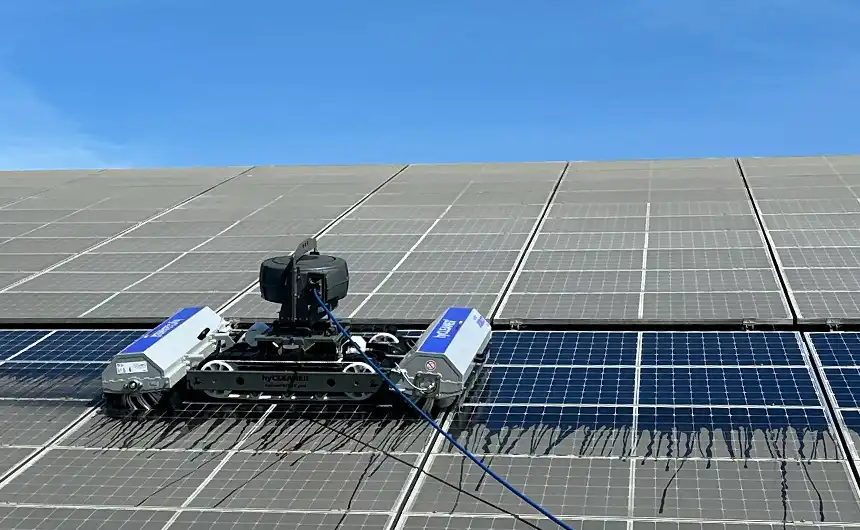
Many surfaces are not designed for high point loads. For example, large glass surfaces and many roofs often cannot be accessed for cleaning the glass surfaces themselves or PV systems due to occupational safety reasons. In such cases, a cleaning robot that is placed on the roof from a work platform and remotely controlled. This robot is designed for the load-bearing capacity of roofs and similar structures, ensuring that cleaning can be performed safely. Furthermore, a robot can reach intricate surfaces, which are becoming more common due to advancements in modern architecture and construction methods.
Furthermore, a robot helps the company save financial resources. This is because, with the perfectly coordinated brush and the correct amount of water, it cleans not only effectively but also more efficiently compared to manual cleaning.
At the same time, the osmosis effect increases the cleaning power. The purified water absorbs particles better because they want to disperse due to osmotic pressure. There are hardly any foreign particles in the water, which is why the osmotic pressure is particularly strong here compared to the dirty surface.
This also has a positive impact on the environment. Thanks to efficient cleaning using only water, no chemicals enter nature or wastewater, which would otherwise have to be treated at great expense. At the same time, the intervals until the next cleaning are extended because dirt no longer adheres to the limescale edges. This also saves resources and protects the environment.
Combined with machine-based cleaning, this makes it possible to achieve not only effective and efficient cleaning, but also sustainable, chemical-free cleaning. With a hand brush, it is not possible to generate sufficient pressure and enough speed in brush rotation to remove even stubborn soiling. By contrast, the cleaning robot ensures, thanks to its high brush rotation and the amount of water matched to it, an optimal cleaning result. In combination with osmosis water, surfaces are also freed from dirt that is difficult to remove, while the water dries without leaving residue and thus slows down re-soiling.
Pure water can generally be used to clean all smooth and closed surfaces that are found on glass facades, metal facades, and solar and PV systems. The following three examples illustrate how osmosis cleaning with a robot works in practice and how companies benefit from it.
Robots and Pure Water: Glass Cleaning for Roofs and More
Glass surfaces such as glass roofs or windows in large industrial halls are generally highly susceptible to dirt and maintenance-intensive, as contamination from weather, exhaust fumes, weathering, vegetation, bird droppings, and so on, quickly becomes visible. At the same time, cleaning is crucial to prevent material fatigue.
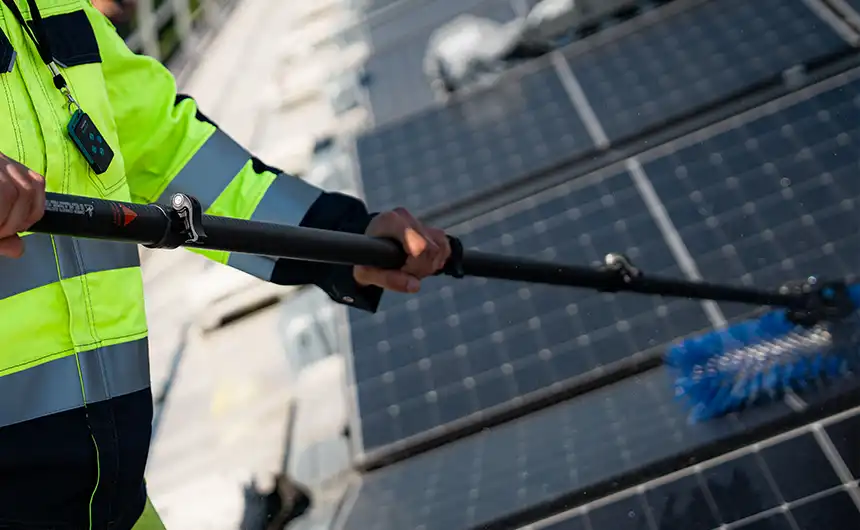
However, cleaning involves a high risk of accidents due to the height, an increased risk of slipping due to dirt and wetness, and modern architecture that makes access more difficult. For multi-storey and extensive buildings, special building shapes, or sloping glass surfaces, osmosis cleaning with a telescopic pole is also no longer possible. This is because many roofs must not be walked on, as this can lead to serious workplace accidents.
A robot, on the other hand, is adapted to the load-bearing capacity and structure of the buildings. The workers stand in the safe basket of an aerial work platform from which they control the robot. A hose supplies the robot with purified water or tap water. Thanks to the cleaning properties of purified water and the efficiency of machine-based cleaning, the intervals until the glass needs to be cleaned again are extended. Osmosis cleaning by a robot therefore improves occupational safety and reduces the cost of materials and the frequency of cleaning.
Cleaning Photovoltaic Systems with Tap Water: Osmosis Cleaning via Robot
Photovoltaic systems perform best when they are clean, as the Institute of Solar Research at the German Aerospace Center writes. However, they also become dirty, for example due to dust, sand, pollen, ammonia, leaves, or bird droppings. This means they must be cleaned regularly to prevent major yield losses. Especially for photovoltaic systems, cleaning with osmosis water and a robot is suitable, as the individual solar cells are very sensitive. Strong cleaning agents with acids or abrasives, hard brushes, or high-pressure cleaners can quickly cause damage here.
At the same time, conventional cleaning methods for large areas are very time-consuming, physically demanding, and uneconomical. Furthermore, for floating or roof-mounted systems, there is a high safety risk for cleaning personnel. Therefore, a robot is also a good solution to address these challenges.
Cleaning Facades: Why Osmosis Water is Suitable for Cleaning
Facades become dirty mainly due to verdigris, lichens, moss, or industrial pollutants. Regular cleaning improves the external appearance and enhances the building’s durability and value retention. Depending on the material, many chemical cleaning agents are too aggressive and can damage the facade. The osmosis process cleans efficiently without chemical agents.
In combination with a facade brush, which is attached to and controlled from a work platform, large areas can be cleaned gently and efficiently at the same time. Therefore, it is also suitable for large shopping centers or furniture stores like Ikea, as well as other large buildings. Practical complete systems, as professional cleaning systems, combine the use of osmosis water and cleaning robots.
The use of technical water is suitable in combination with robot-assisted cleaning to clean surfaces efficiently, effectively, and sustainably. This is because the two techniques combine a wide range of advantages: thanks to the high mechanical brushing performance and the use of osmosis water, chemicals can be completely avoided. The robot also enables companies to meet the highest safety standards, as employees control it safely from the basket of an aerial work platform.
Osmosis cleaning combines economic, ecological, and safety-related advantages in one modern cleaning system. By using pure water, PV systems, glass surfaces, and facades can be cleaned effectively without having to use aggressive chemicals.
Especially in combination with mechanical brush systems and cleaning robots, companies benefit from:
Particularly for large industrial surfaces, glass roofs, and photovoltaic systems, the combination of osmosis water and robot-assisted cleaning enables a significantly more efficient way of working than conventional cleaning methods.
For building cleaners, PV service providers, and industrial companies, osmosis cleaning is therefore increasingly becoming the professional standard.
Whether it’s an agricultural rooftop system, a commercial roof or a large solar park—the economically optimal cleaning solution depends on system size, location and degree of soiling. Together, we analyze your system and recommend the right cleaning concept.
Our cleaning solutions at a glance
solarROBOT compact
For agricultural as well as small and medium rooftop systems up to approx. 200 kWp. The cleaning robot can be used independently by the system operator and is supplied including a charging station. CE-certified and developed specifically for cost-effective in-house operation.
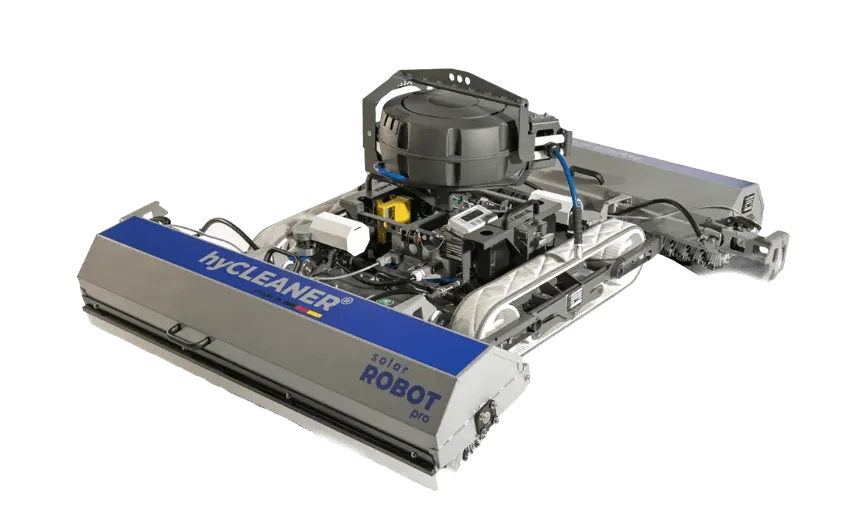
solarROBOT pro
For medium-sized commercial and ground-mounted systems. With a working width of up to 2 meters and semi-automated operation, the solarROBOT Pro is ideal for efficient cleaning of larger module areas.
solarROBOT ultimate
For large-scale systems and ground-mounted projects. With a working width of 2.4 meters, maintenance-free chain drive and high area performance, the solarROBOT Ultimate was developed for professional use on large PV systems.
solarBRUSH 600
The handheld cleaning solution for special constructions, complex roof geometries and professional cleaning service providers. Ideal for applications where cleaning robots cannot be used due to the design.

For agricultural as well as small and medium rooftop systems up to approx. 200 kWp. The cleaning robot can be used independently by the system operator and is supplied including a charging station. CE-certified and developed specifically for cost-effective in-house operation.
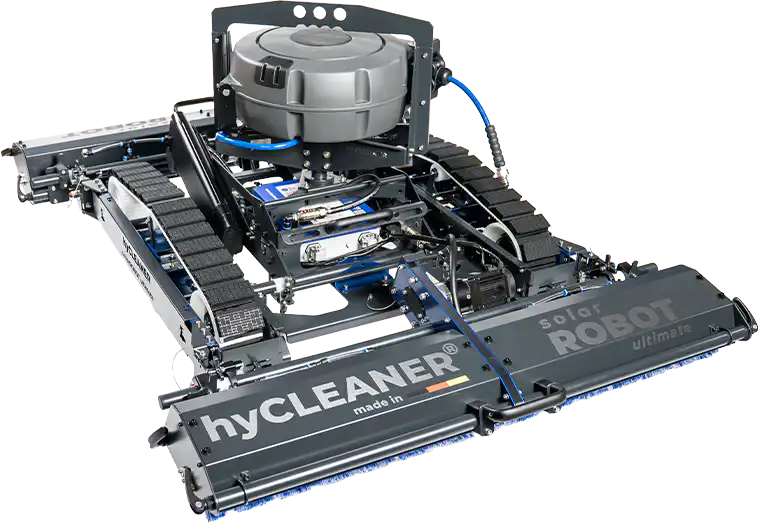
For large-scale systems and ground-mounted projects. With a working width of 2.4 meters, maintenance-free chain drive and high area performance, the solarROBOT Ultimate was developed for professional use on large PV systems.
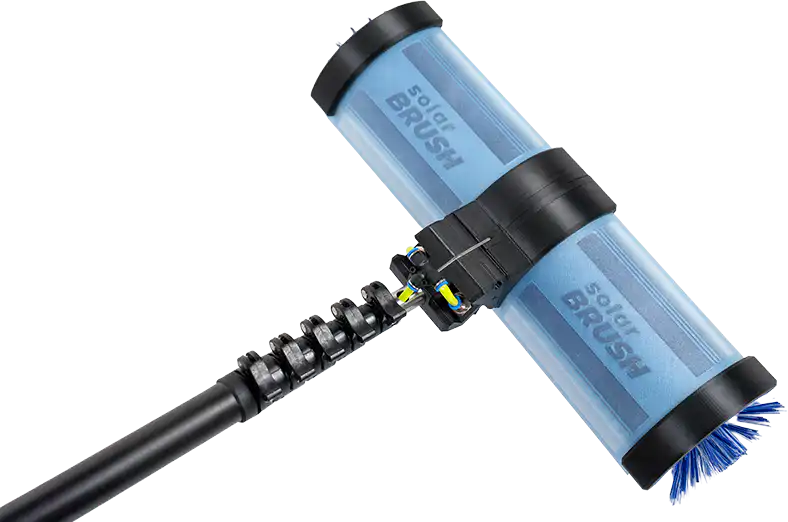
The handheld cleaning solution for special constructions, complex roof geometries and professional cleaning service providers. Ideal for applications where cleaning robots cannot be used due to the design.
All systems clean without chemicals or soap using pure water and enable gentle, material-friendly cleaning of PV systems.
We analyze your system portfolio, calculate your individual cleaning needs and recommend the economically optimal cleaning concept—from a single system to a multi-site park.
Osmosis water has been stripped of minerals, lime, and salts and therefore dries almost completely residue-free. Tap water, on the other hand, leaves behind residues to which new dirt adheres more quickly.
PV modules are sensitive to aggressive cleaning agents, hard brushes, and lime scale. Osmosis water cleans the surface gently while simultaneously reducing performance losses caused by soiling.
The optimal cleaning frequency depends on the location and the degree of soiling. Especially in agriculture, industrial areas, or locations with high dust exposure, regular cleaning may be necessary to avoid yield losses.
Cleaning robots improve occupational safety and enable efficient cleaning of large roof, glass, and PV surfaces. At the same time, they reduce physical strain and significantly increase area performance.
For large and regular cleaning jobs, reverse osmosis systems are considered significantly more economical. Mixed-bed resin filters are more suitable for smaller and sporadic applications.
Calculate your individual yield loss with the hyCLEANER solar loss calculator.
We recommend the economically right cleaning concept for your system.
Why is it worth entering PV cleaning? Growing market, recurring revenues, and scalable business models through modern robotic technology.
How much does a dirty solar system cost? Example calculations for agriculture, commercial roofs and ground-mounted systems – incl. yield losses and cleaning intervals.
Photovoltaic expert Pascal Kierstein explains the most common defects in commercial PV systems and shows how operators can prevent damage.