


How Often should Solar Panels be Cleaned?
Why regular cleaning ensures performance and yield
- Expert Knowledge
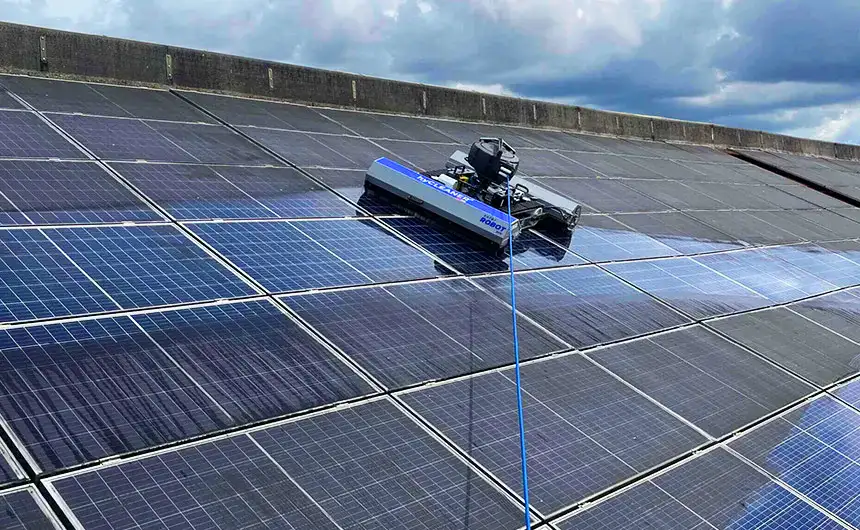
One thing is certain: companies must also clean their solar panels regularly – but how often is really necessary? Only clean PV systems work efficiently and maintain their full performance. But when is the right time for cleaning? How do you recognize that solar modules are dirty, and how should you best clean them? We answer the most important questions and show you what costs you can expect with professional cleaning.
Do you have to clean a PV system? Effects of contamination and Co.
The short answer: Yes, PV systems require regular cleaning. To convert sunlight into electricity, solar modules need direct exposure to the sun. However, it is perfectly natural for them to become dirty over time. There are several reasons for this:
- Natural contaminants: Dust from the air, windblown sand, leaves and seeds from surrounding trees, flower pollen, bird droppings, lime from rain that is dried by the sun
- Chemical deposits: Industrial and car exhaust fumes, tire abrasion, oil particles and fine dust, soot from surrounding chimneys
- Secondary soiling: Sand and dust offer optimal living conditions for fungi, lichens and mosses, which form during prolonged soiling
Depending on the tilt angle of the PV system, rain, wind, and snow remove coarse debris. However, stubborn dirt such as bird droppings, industrial emissions, and vehicle exhaust often remain stuck to the surface. When such contaminants accumulate on the solar panels, sunlight can no longer reach the modules, leading to a decrease in efficiency.
This also leads to secondary contamination, which traps even more dirt on the system, providing a breeding ground for lichens, moss, and fungi. This creates a vicious cycle that can only be broken through effective cleaning. If dirt becomes lodged along the edges or underneath, it becomes increasingly difficult to remove.
The fact that a steep surface is not cleaned exclusively by rain, wind and snow is also demonstrated by St. Stephen’s Cathedral in Vienna. Although the roof surfaces are relatively steep, moss and lichens have accumulated here, among other things, as the news portal NÖN.at reports. The problem: The plants store water, which freezes in winter and causes roof tiles to burst. With the help of professional cleaning, however, the roof can be freed from the contaminants.
Cleaning PV modules: When is it worth it?
Whether cleaning is worthwhile depends on the losses caused by the contamination. These losses must be weighed against the cost of the cleaning itself. This can be calculated using a loss calculator.
Empirical data shows that losses between 8% and 30% are quickly reached depending on the location. For example, we observe approximately 12% contamination on many commercial roofs, and up to 30% in agriculture. Open spaces often show a better value of approximately 5–10% due to their location.
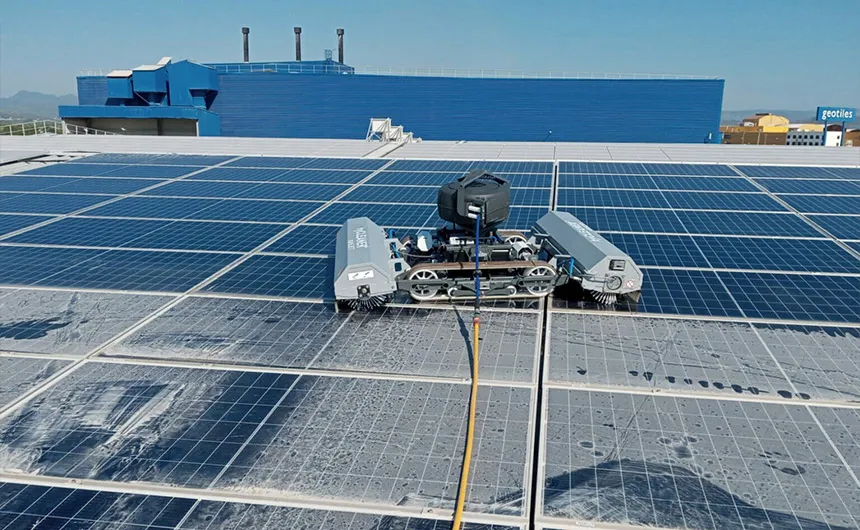
Hot spots caused by heavy soiling can destroy solar panels
In the event of heavy soiling, there is also a risk of hot spots: If individual cells are completely shaded by the soiling, they no longer generate electrical voltage. As a result, they act like a barrier in the series connection of the solar module, while the others continue to generate electricity. If the operating or reverse voltage of the shaded cell is now broken, the voltage drops and the current flows unhindered. As a result, the solar cells can overheat so much that they are destroyed.
How often should a solar system be cleaned? The influence of location and tilt angle
Contrary to the misconception of many, experience shows that dirt such as leaves is only removed with a very steep inclination. However, even here the modules become dirty due to rain, snow and wind, which transport small dust particles and Co. onto the surfaces of the solar modules. Systems on commercial properties are also flatter than others and therefore tend to need to be cleaned more often. Here, robot-assisted cleaning is the means of choice for efficient yield maximization, as the terrain and the type of installation are often a difficult and unsafe environment to clean.
In Europe, the soiling pattern and the location criteria that lead to the soiling are very different. It is therefore very individual how often a PV system needs to be cleaned. In the vicinity of industrial and agricultural businesses, the systems tend to need to be cleaned more often than, for example, in urban areas. This is because more exhaust fumes and dust particles are deposited here. In principle, the interval can be about every six weeks to several years.
Cleaning Solar Panels: how to Recognize when Cleaning is Necessary
Cleaning involves costs and must therefore be balanced against the loss of yield from reduced power generation and the shortened lifespan of the modules caused by dirt. However, it is clear that companies must clean their solar systems at regular intervals. As a general rule, they should be visually inspected at least once a year. If contaminants such as layers of dust, grime buildup, bird droppings, or other deposits are clearly visible, cleaning is long overdue. Typically, a system is cleaned once a year to prevent the growth of moss.
The Right Time to Clean Solar Panels
For professional cleaning companies, the key is determining when to achieve the best results with the least effort. Generally, PV modules should not be cleaned during extreme heat or frost. To achieve optimal results, one to two cleanings per year are recommended. Ideally, these should take place after the cold season or the first pollen season, and again after the dry period in autumn. This ensures that the typically low-yield winter months begin under optimal conditions to maximize output. For stubborn dirt, rainy periods can help by pre-soaking the surface. If a specialist company cleans the solar system immediately following rain, stubborn grime is much easier to remove.
Cleaning PV Modules: these Methods Work Best
Before cleaning starts, it makes sense to check the system: Are elements broken or cables damaged? What do the surfaces of the PV modules look like? If major damage is visible, the power should be switched off and the system repaired to avoid safety risks. During cleaning itself, cleaning agents and brushes, among other things, influence how companies best clean solar modules.

Cleaning solar systems: The challenges of manual systems for industrial facilities.
There are various options for cleaning itself. Manual systems often work via a rod that is operated from the ground or a work platform. However, this is very tedious very quickly in industrial plants and can involve high safety risks. Here, a robot system is a good alternative, as it cleans large areas efficiently and safely.
The Right Cleaning Agent for Solar Cleaning
No harsh agents are suitable as cleaning agents, as these attack the materials of the system and get into nature unfiltered if they are not collected in a complicated manner. Instead, robot-assisted cleaning is suitable, for example, as the high brush rotation has a strong cleaning effect. This makes the use of chemical agents superfluous. Another advantage in combination with the robot is osmosis cleaning, as it keeps re-soiling to a minimum. Once the surfaces have been completely cleaned by the robot and osmosis water is used, it dries without leaving any residue. This prevents the formation of limescale deposits, which accelerate re-soiling.
Solar modules and high-pressure cleaner? The right mechanical cleaning
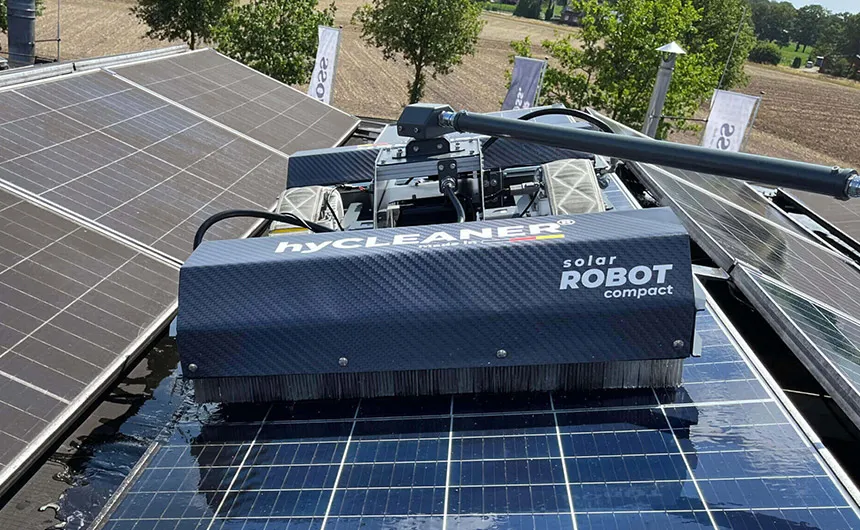
A high-pressure cleaner is not suitable for cleaning, as it exerts too much pressure on the solar modules in certain areas and can therefore damage them. Instead, rotating brushes, such as those found in solar and PV cleaning robots, gently and effectively remove the dirt that sticks to the surfaces due to chemical reactions, for example.Thanks to the special brush design with gentle rotation and the water quantity matched to it in a cleaning robot, companies achieve effective and efficient cleaning at the same time, without exerting too much pressure on the PV modules in certain areas and damaging them in this way. This makes the robots the perfect alternative to high-pressure cleaners. The solarROBOT pro, for example, with a brush rotation of around 400 rpm and long bristles, is suitable for solar surfaces from 2000 m2 , while the solarROBOT compact cleans smaller systems from 150 m2.
Cleaning PV Systems with Robots: Occupational Safety and Efficiency
The robots also have the advantage that they can be controlled from a work platform. As a result, cleaning staff do not have to enter the sensitive solar modules or the roofs, which significantly increases occupational safety. In addition, roofs are often not designed for a person to stand on them to clean the modules. The selective pressure would be too great here. For large roof areas with more than 150 kWp, robot-assisted systems are generally much more efficient than conventional manual systems. While the latter clean an average of between 50 and a maximum of 300 square meters per hour depending on the brush, a robot system manages ten times that. In addition, it achieves a constant work result throughout the day.
PV System Cleaning Costs: these are the Factors for the Price
The costs for cleaning PV systems depend on the method, the system size and its condition. Cleaning companies and businesses can keep their costs down with the right equipment. We offer various PV cleaning robots that clean gently and effectively thanks to their high brush rotation. Whether east-west, south-facing or long, contiguous surfaces – the robot can be used flexibly depending on the requirements and can also reach difficult areas without any problems. In combination with a reverse osmosis system, they are an excellent way to clean large solar systems effectively and cost-effectively as professional cleaning systems.
Cleaning solar panels – How often? Regularly for best efficiency and longevity of the solar modules
Regular cleaning of the PV system is important in order to achieve the best possible yields in the long term. At the same time, it protects the solar modules from stubborn dirt such as lichens, moss, leaves, dust particles and Co. in order to be able to use the investment of a large solar system as effectively as possible for as long as possible. Cleaning is best carried out on cooler days and times and after longer rainy phases, which have already soaked the dirt beforehand. Cleaning robots ensure thorough and gentle cleaning with a high level of occupational safety for employees.
Would you like to learn more about the possibilities of a cleaning robot or our cleaning systems? Then please contact us; we would be happy to advise you!