Why is it worth entering PV cleaning? Growing market, recurring revenues, and scalable business models through modern robotic technology.

Startseite ❯ Solar-Fachartikel ❯ Expert Knowledge ❯ The perfect PV cleaning device – the right solution for your solar surface
Find the right PV cleaning device
For operators and professional PV cleaners
At a time when renewable energy is becoming increasingly important, the efficiency of photovoltaic systems is crucial. Contamination such as dust, pollen, or bird droppings can significantly reduce module performance. That is why regular cleaning ensures the system operates reliably and delivers high yields. At the same time, it extends the service life of the modules. Choosing the right PV cleaning device is therefore a key factor for cost-effective operation.
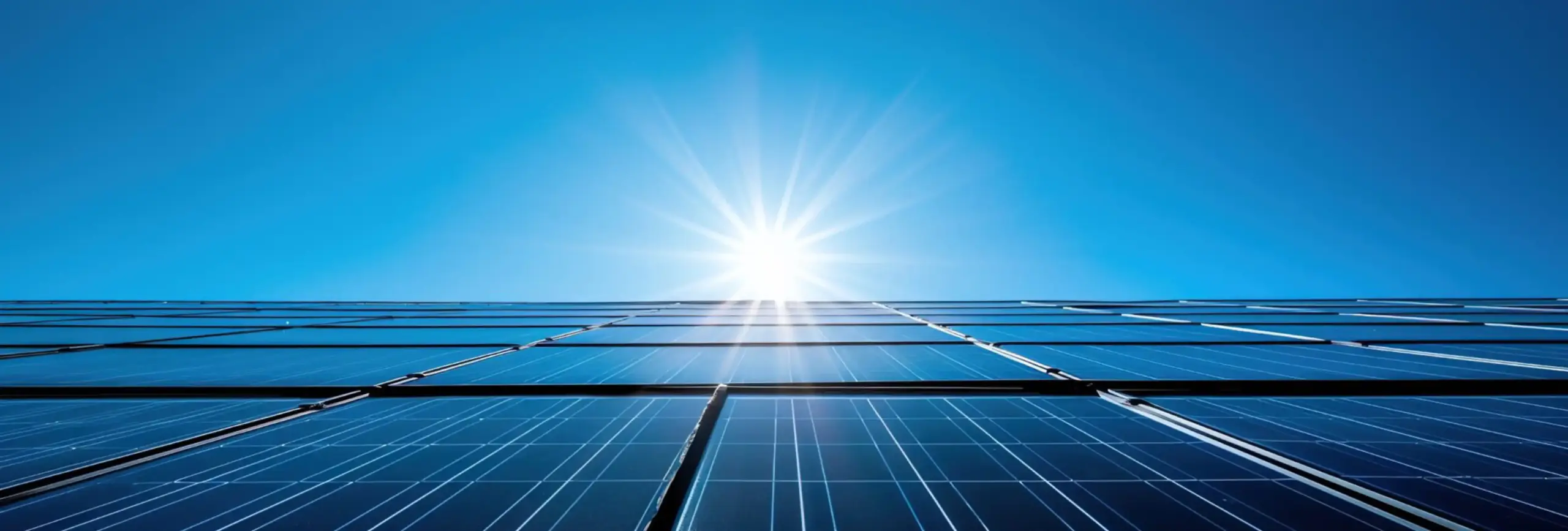
A suitable PV cleaning device affects the entire cleaning process, as it determines how quickly, safely, and thoroughly the work can be carried out.
Unsuitable systems often lead to:
With the right technology, cleaning processes can be standardized. This saves time and ensures consistently high quality.
The ergonomics of a PV cleaning device determine how efficiently you can work while also reducing physical strain. Poor handling quickly leads to fatigue, uneven cleaning results, and long-term strain on personnel.
Especially with larger systems or longer deployments, it becomes clear how strongly weight, balance, and grip position influence performance. Ergonomically optimized systems provide better control, reduce the effort required, and ensure consistently high-quality results.
Photovoltaic systems vary greatly. Large areas have different requirements than small systems.
These factors also play a role:
That is why there is no single device that is equally suitable for all systems. Instead, the cleaning technology must be adapted to the specific situation. Only then can efficiency, safety, and cost-effectiveness be optimally combined.
"There is no one-size-fits-all PV cleaning device. It is crucial that the cleaning technology matches the system size, roof pitch, accessibility, and degree of soiling."
Josha Kneiber, Geschäftsführer hyCLEANER
Choosing the right PV cleaning device depends largely on the technical and structural characteristics of the photovoltaic system. Not every cleaning method is suitable for every system—the decisive factor is the right combination of surface size, accessibility, and degree of soiling.
The most important influencing factors include:
Ultimately, these factors determine whether manual cleaning is sufficient or whether using an automated system makes sense.
A cleaning robot is a good option when manual methods reach their limits or are no longer cost-effective.
Typical areas of use include:
Robots enable consistent and efficient cleaning. At the same time, they significantly reduce staffing requirements and improve occupational safety.
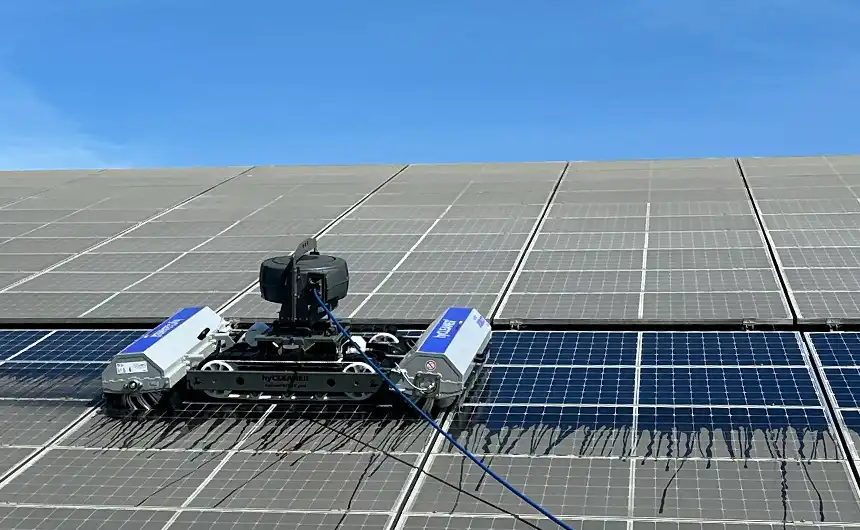
Photovoltaic cleaning robots are particularly suitable for large installations such as solar parks, industrial and commercial roofs, or agricultural areas.
They offer key advantages:
This makes them the preferred solution, especially for professional applications.
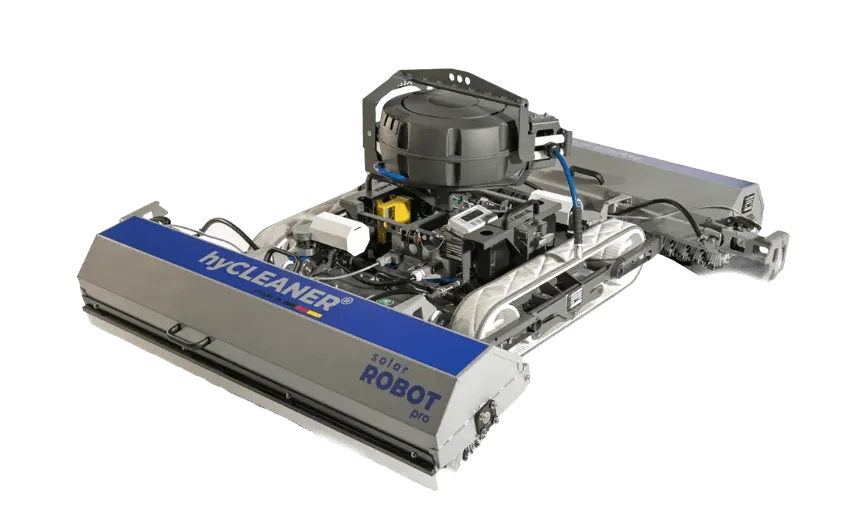
solarROBOT pro – for large, contiguous installations
The solarROBOT pro is a powerful professional device for large photovoltaic systems. Thanks to variable brush widths, cleaning performance can be flexibly adjusted and increased as needed.
It can be used on surfaces with an incline of up to 25°. With additional side guidance, the robot also works reliably on steeper surfaces.
Ideal for large-scale installations where efficiency and speed are critical.
solarROBOT compact – for smaller and complex PV surfaces
The solarROBOT compact was developed specifically for smaller or segmented PV surfaces.
Its compact design and low weight make it easy to transport and flexible to use. It shows its strengths especially on east–west systems or in hard-to-reach areas.
Suitable for surfaces with an incline of up to 20°.
The optimal solution for flexible use on complex installations.
solarROBOT Dirt Force – for stubborn soiling
The solarROBOT Dirt Force is designed for heavy soiling such as bird droppings, dust, or industrial residues.
With increased cleaning performance, it reliably removes even stubborn deposits while remaining gentle on materials.
Particularly suitable for heavily soiled PV systems or those that have not been cleaned for a long time.
The right brush width determines how quickly and thoroughly you can clean your system. At the same time, it directly affects area coverage and workload—because depending on the width, you will need more or fewer passes. Modern systems show how much cleaning performance can be increased with adapted brush widths by flexibly expanding the working width and thus cleaning significantly more area per pass.
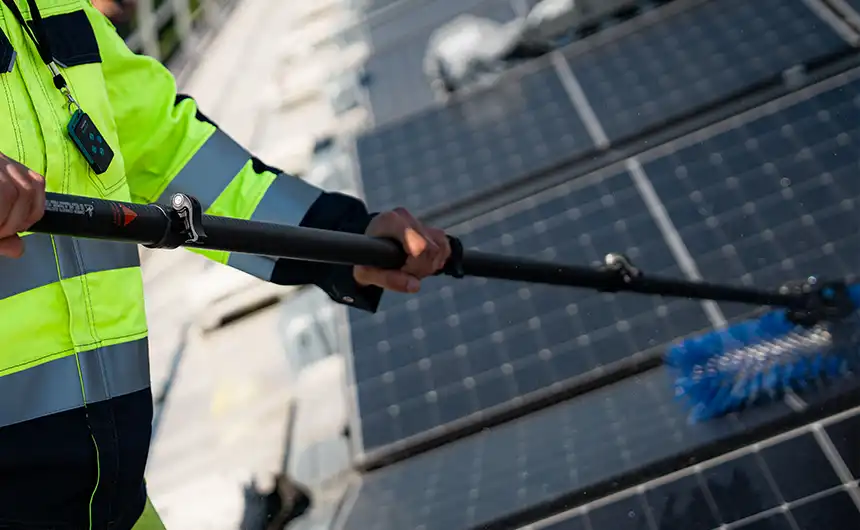
Not every system can be cleaned fully automatically. That is why hand brushes are an important addition to the cleaning system.
They are particularly suitable for:
A hand-brush set also offers a cost-effective entry into PV cleaning and can be ideally combined with robot systems.
Water quality plays a crucial role in cleaning photovoltaic systems. Osmosis water offers an effective and environmentally friendly alternative to chemical cleaning agents.
Benefits:
In combination with brush systems, osmosis water enables particularly thorough, material-friendly, and sustainable cleaning.
Water delivery determines how evenly water reaches the module surface and how effectively soiling is loosened. Optimized distribution not only reduces water consumption, but also ensures better, streak-free cleaning results.
Especially with large installations or stubborn soiling, it becomes clear how strongly water delivery influences the efficiency of the entire cleaning process. Modern systems therefore rely on integrated water channels and adjustable flow rates to apply water precisely where it is needed.
In practice, many service providers work with complete systems that combine all relevant components.
These include:
Such a system enables maximum flexibility and ensures that a wide variety of installations can be cleaned efficiently and cost-effectively.
Choosing the right PV cleaning device depends on the system’s individual requirements:
Only the right combination of these systems results in an efficient, safe, and cost-effective cleaning concept.
hyCLEANER supports operators of industrial photovoltaic systems as a technology partner in the field of robot-assisted solar cleaning. Contact us – for an individual analysis of your system and a non-binding quote.
Whether it’s an agricultural rooftop system, a commercial roof or a large solar park—the economically optimal cleaning solution depends on system size, location and degree of soiling. Together, we analyze your system and recommend the right cleaning concept.
Our cleaning solutions at a glance
solarROBOT compact
For agricultural as well as small and medium rooftop systems up to approx. 200 kWp. The cleaning robot can be used independently by the system operator and is supplied including a charging station. CE-certified and developed specifically for cost-effective in-house operation.
solarROBOT pro
For medium-sized commercial and ground-mounted systems. With a working width of up to 2 meters and semi-automated operation, the solarROBOT Pro is ideal for efficient cleaning of larger module areas.
solarROBOT ultimate
For large-scale systems and ground-mounted projects. With a working width of 2.4 meters, maintenance-free chain drive and high area performance, the solarROBOT Ultimate was developed for professional use on large PV systems.
solarBRUSH 600
The handheld cleaning solution for special constructions, complex roof geometries and professional cleaning service providers. Ideal for applications where cleaning robots cannot be used due to the design.

For agricultural as well as small and medium rooftop systems up to approx. 200 kWp. The cleaning robot can be used independently by the system operator and is supplied including a charging station. CE-certified and developed specifically for cost-effective in-house operation.
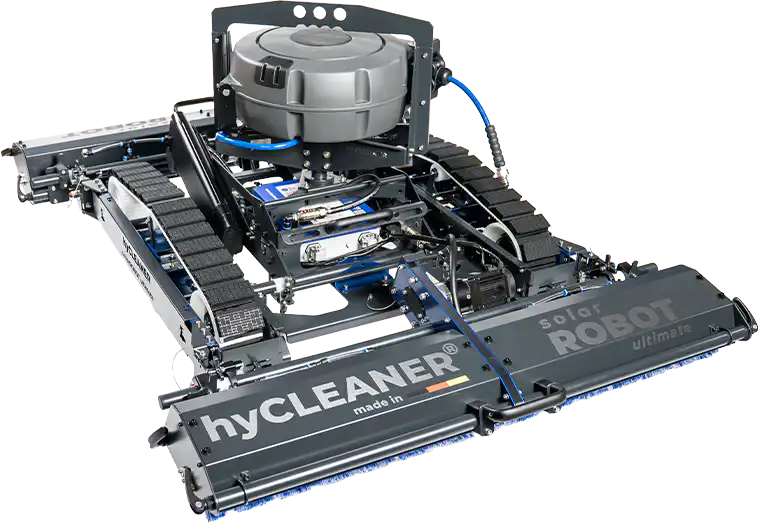
For large-scale systems and ground-mounted projects. With a working width of 2.4 meters, maintenance-free chain drive and high area performance, the solarROBOT Ultimate was developed for professional use on large PV systems.
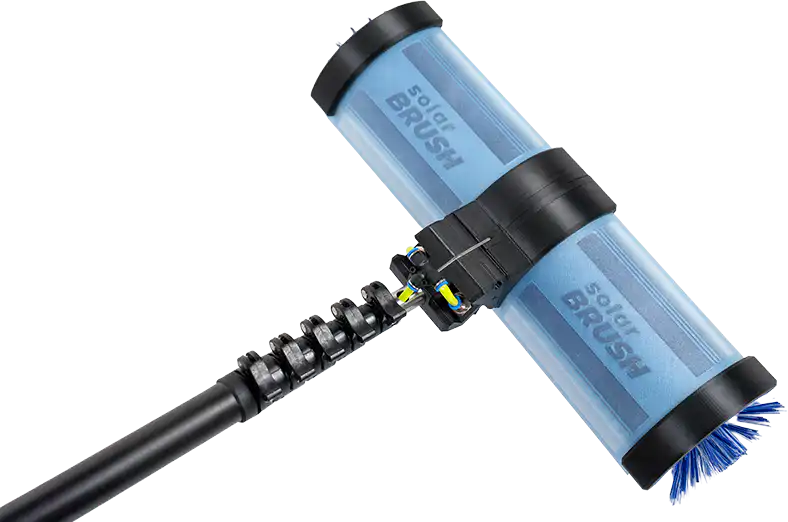
The handheld cleaning solution for special constructions, complex roof geometries and professional cleaning service providers. Ideal for applications where cleaning robots cannot be used due to the design.
All systems clean without chemicals or soap using pure water and enable gentle, material-friendly cleaning of PV systems.
We analyze your system portfolio, calculate your individual cleaning needs and recommend the economically optimal cleaning concept—from a single system to a multi-site park.
Calculate your individual yield loss with the hyCLEANER solar loss calculator.
We recommend the economically right cleaning concept for your system.
Why is it worth entering PV cleaning? Growing market, recurring revenues, and scalable business models through modern robotic technology.
How much does a dirty solar system cost? Example calculations for agriculture, commercial roofs and ground-mounted systems – incl. yield losses and cleaning intervals.
Photovoltaic expert Pascal Kierstein explains the most common defects in commercial PV systems and shows how operators can prevent damage.